Supertrend
Also called ST
Supertrend is a single ATR-based line plotted on price that flips above or below it to show trend direction and acts as a trailing stop.
Supertrend is a single line plotted on price that marks the current trend direction and doubles as a trailing stop. It is built from the Average True Range, so it sits closer to price in quiet markets and further away when volatility rises. Traders use it to read trend direction at a glance, time entries on a flip, and trail stops without recalculating a fixed distance by hand.
The ATR formula behind the Supertrend line
The line is built from two bands around the midpoint of each candle:
Basic Upper Band = (High + Low) / 2 + Multiplier × ATR
Basic Lower Band = (High + Low) / 2 − Multiplier × ATR
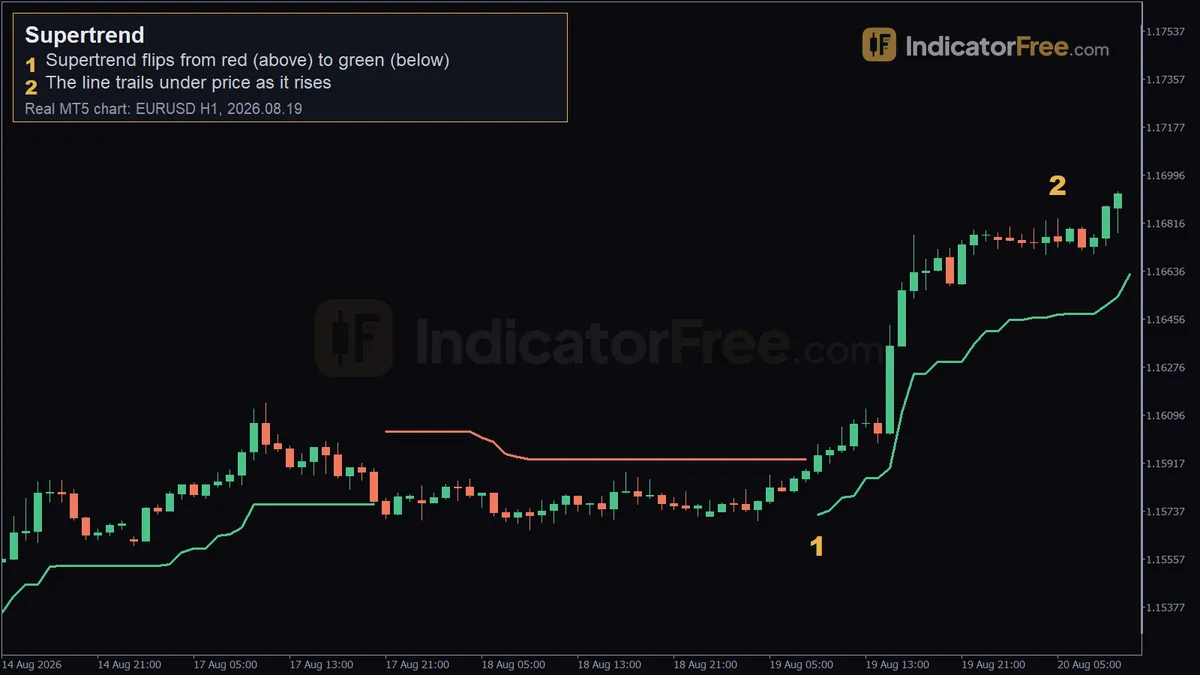
The final line follows the lower band while price trades above it (uptrend, line in green, sitting below price) and the upper band while price trades below it (downtrend, line in red, sitting above price). When a candle closes on the other side of the active band, the line flips to the opposite band and changes color. That flip is the whole signal: the line itself is really a volatility-adjusted stop level, not a moving average.
Reading the Supertrend flip on a chart
On the EURUSD H1 chart above, the Supertrend(10,3) flipped from red to green on 2026.08.19 at 09:00, with the line at 1.15723 while the candle closed at 1.15946. The chart marks this flip at 1.15878 on that same candle. From there the line trailed underneath rising price, and by 2026.08.20 at 05:00 it had moved up to 1.16835 while price had gained 89 pips over 20 candles. That is a past example on this one chart, not a pattern to expect every time a flip happens.
When the Supertrend indicator works well, and when to leave it alone
Works well when:
- The market is trending, with sustained swings in one direction rather than chop
- Read on H1 and higher timeframes, where candle ranges reflect real volatility
- Combined with a higher-timeframe trend read before acting on the flip
Avoid or be cautious when:
- The market is ranging — price crosses the line back and forth and produces false flips
- Used alone on very low timeframes (M1/M5), where spread and noise trigger flips that reverse almost immediately
- Right before or during high-impact news releases, since the resulting ATR spike widens the bands and distorts the line
Supertrend pros and cons
| Pros | Cons |
|---|---|
| Plots directly on price, easy to read at a glance | Lags at the start of a new trend, like any ATR-based tool |
| Gives a clear stop level that moves with the trend | Produces false flips in ranging markets |
| Only two inputs to tune, period and multiplier | Reacts to price after the move starts, it does not predict reversals |
| Combines direction and a trailing stop in one line | Period and multiplier choice changes results a lot and needs testing per pair |
Trading the Supertrend flip
//EURUSD H1: the 2026.08.19 flip from red to green
Entry trigger: wait for the candle to close on the new side of the line, not just touch it. On this chart the flip candle closed at 1.15946, above the 1.15723 band level, and the chart marks the flip itself at 1.15878 on that same 09:00 candle. The confirmed close is the signal; there is no separate next-candle wait built into the indicator.
Stop loss: place it below the flip level, around 1.15723, or below the most recent swing low under that price.
Exit: trail the stop under the Supertrend line as it rises instead of using a fixed distance. By 2026.08.20 at 05:00 the line had moved up to 1.16835 as price gained 89 pips over 20 candles, so the stop would have moved up with it. Exit the full position if the line flips back above price. This is a walk-through of one past chart, not a forecast of future moves.
Choosing the Supertrend period and multiplier
| Trading style | Timeframe | Typical period / multiplier to test | Why | |---|---|---| | Scalping | M5 / M15 | Shorter period (around 7–10), tighter multiplier (around 2) | Reacts faster to short swings, at the cost of more flips | | Day trading | H1 | Medium period (around 10–14), multiplier around 2–3 | Balances noise and lag; close to the (10,3) setting used in the EURUSD H1 example above | | Swing trading | H4 / D1 | Longer period (14–20+), multiplier around 3 | Filters short-term noise, holds through bigger swings |
These are starting points to test, not fixed rules. Gold (XAUUSD) has much wider candle ranges than major FX pairs, so the same period and multiplier that suit EURUSD or GBPUSD often need a wider multiplier on gold, or they will flip on normal price swings rather than real trend changes.
Practical tips for using Supertrend on MT5
- Don't act on a flip in isolation; confirm it against a higher-timeframe trend or recent structure
- Use the line itself as your trailing stop instead of a fixed pip distance
- Widen the multiplier on volatile symbols like gold so normal swings don't trigger an exit
- Test the period and multiplier on the exact symbol and timeframe you plan to trade, since a setting that suits EURUSD H1 may not suit GBPJPY M15
- Treat a flip that happens during a news spike with caution; wait for the next candle to confirm it holds
- Pair it with a volume or momentum reading to cut down on whipsaw during quiet sessions
Quick checklist before you trade a Supertrend flip
- The candle has closed on the new side of the line, not just touched it
- The higher-timeframe trend agrees with the flip direction
- No major news event is due in the next few candles
- The stop loss sits beyond the flip level, not inside it
- The period and multiplier have been tested on this exact symbol and timeframe
FAQ
Is the Supertrend indicator the same on TradingView and MT5? The underlying ATR-based formula is the same on both platforms. Only the input labels and default colors tend to differ, so a (10,3) setting behaves the same way wherever it's applied.
What is a Supertrend strategy? Most Supertrend strategies use the flip as an entry trigger and the line itself as a trailing stop, usually filtered by a higher-timeframe trend or a second indicator to cut down on false flips during ranging markets.