Stop order
Also called stop entry order, entry stop, stop-entry order
A stop order is a pending order that tells your broker to buy once price rises to a level above the market, or sell once it falls to a level below it. When price touches that level, it becomes a market order and fills at the next available price.
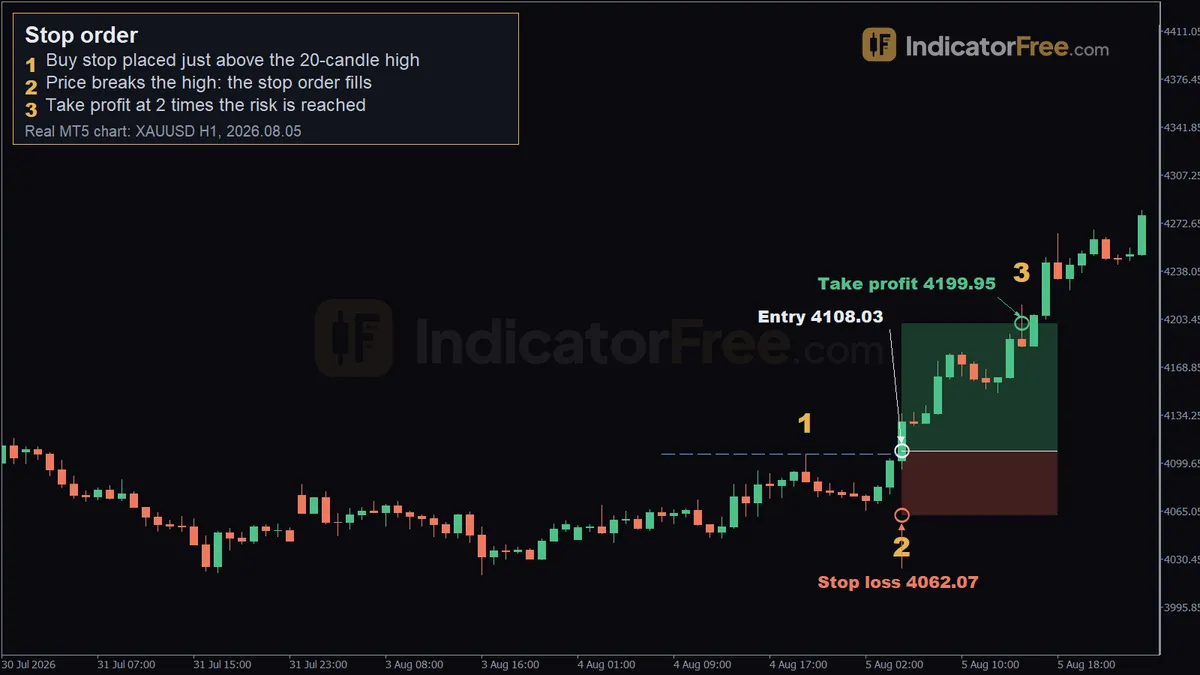
The level you type is a trigger, not a promised fill price. That one detail decides how much you really risk on a breakout trade, and it is why your fill can differ from your plan.
What a stop order does while you wait
A stop order lets you enter only if price proves the move first. If the breakout never comes, you never enter.
Stop order, stop loss and limit order compared
A stop loss is the same mechanism pointed the other way: a stop order attached to an open trade that closes it at a loss you chose in advance.
| Order | Where it sits | What it does when touched |
|---|---|---|
| Buy stop | Above current price | Opens a buy at the next available price |
| Sell stop | Below current price | Opens a sell at the next available price |
| Stop loss | On the losing side of an open trade | Closes the trade at the next available price |
| Limit order | At a better price than now | Opens a trade at your price or better |
Decision rule: if you want confirmation and accept a slightly worse price, use a stop order. If you want a better price and accept that you may miss the trade, use a limit order.
How a stop order changes your entry price and risk
The chart at the top shows a real case from the past, not a prediction: on EURUSD 1-hour candles, a buy stop sat just above the 20-candle high at 1.1726 and filled at 1.17272, about 1 pip above the level, with 24 pips of risk and 48 pips of reward.
The figures here are an illustrative example. A pair ranges under 1.1000. You place a buy stop at 1.1005, a stop loss at 1.0975 and a take profit at 1.1065. That is 30 pips of risk and 60 pips of reward, which the chart below shows.
You trade 0.10 lots, which is 10,000 units and $1 per pip. A candle chart cannot show the ticks inside one candle. Say price moves fast through your level during the breakout candle and the order fills at 1.1008, not 1.1005. That 3-pip gap is slippage: the difference between the price you asked for and the price you got.
Your stop loss and take profit prices did not move, but your entry did. $57 ÷ $33 ≈ 1.7, so the planned 2 to 1 trade became roughly 1.7 to 1.
Checks before you place a stop order
- Buy stops trigger on the ask price. Most charts draw the bid, so a buy stop can fill when the candle has not visibly touched your line. Add the spread to your level if you want the chart to break first.
- Leave a buffer. A level exactly on the high gets hit by a one-tick poke. A few pips beyond filters some of those.
- Size from the stop distance. Divide your money risk by (stop pips × pip value per lot). In the example above: $30 ÷ (30 pips × $10 per pip per lot) = 0.10 lots.
- Mind news and weekend gaps. Price can skip your level and fill far beyond it. The same gap can close your trade well past your stop loss, so the money you lose can be bigger than you planned.
- Check the minimum distance. Many brokers set a minimum distance from the current price and reject a stop order placed inside it.
- Cancel the leftover. If you placed a buy stop and a sell stop around a range, remove the unfilled one after entry.
- Expect fills while you are away. Once accepted, the order is normally held on the broker's server, so it can fill while your device is off.
FAQ
Does a stop order expire if price never reaches it?
Only if you set an expiry. Without one it stays active until you cancel it, which means an old order can fill days later on a setup that no longer exists.
What is a stop-limit order?
It is a stop order with a price cap. When the stop level is touched, a limit order is placed, so you are not filled worse than your limit. The cost is that a fast move can leave you with no fill at all.
Do I pay anything for a stop order that never fills?
Normally no. Spread and commission apply when the order fills and a trade opens.