Stop loss
Also called SL, stop-loss, stop loss order, protective stop
A stop loss is an order attached to a trade that closes it automatically when price moves against you to a level you chose in advance. It fixes the most you plan to lose on that trade before you open it. You enter it as a price in the order window.
A stop loss only protects you if two numbers agree: where the stop sits on the chart, and how many lots (the size of the trade) you open. Get the level right and the size wrong, and one ordinary losing trade can still take a large bite out of your account.
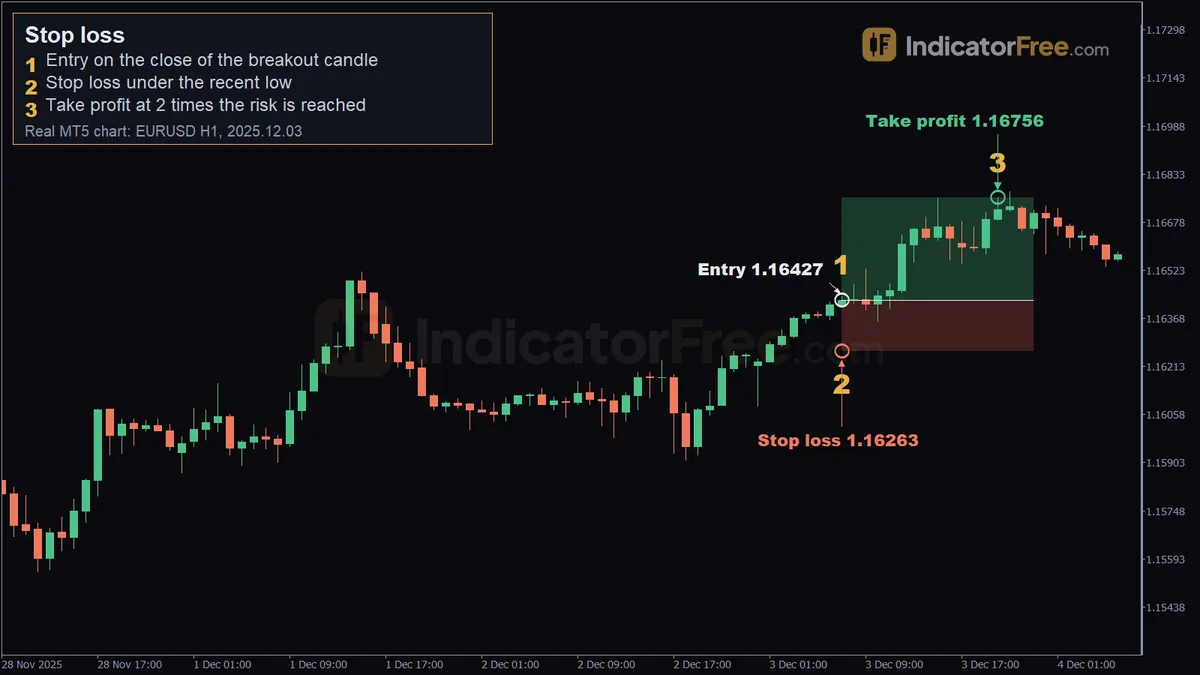
On the EURUSD 1-hour chart at the top of this page, a past buy was entered at 1.16427 with the stop loss under the recent low at 1.16263. That put 16.4 pips at risk (1.16427 - 1.16263; a pip is the fourth decimal on EURUSD). It is a past example, not a prediction.
Where to put the stop: the level that proves the trade wrong
Put the stop where your reason for the trade stops being true. A swing low is a dip where price turned back up: a low with higher lows on both sides. A swing high is the mirror: a peak where price turned back down, with lower highs on both sides. In the chart below, the candle marked "Swing low" is one: its 1.0980 low has higher lows on both sides. For a buy, the stop usually goes just below the last swing low. For a sell, it goes just above the last swing high.
The usual error is choosing a stop because it is cheap. A stop placed inside the normal back-and-forth of price gets hit by a routine dip, and then price goes your way without you.
The chart below shows one buy with two possible stops. The tight stop sits inside the pullback and is hit before the move up. The stop below the swing low stays open through the same dip.
A wider stop does not have to mean a bigger loss. You keep the money at risk the same by trading fewer lots.
The stop loss formula: price level, then money at risk
A stop loss answers two questions. Where does the trade close, and what does that cost?
Buy trade:   stop price = entry price - stop distance
Sell trade:  stop price = entry price + stop distance

Money at risk = stop distance in pips x pip value per lot x lots
Lots          = money you accept to lose / (stop distance in pips x pip value per lot)
The stop distance is the gap between your entry and your stop, counted in pips. The pip value is what one pip of movement is worth in money. On a pair quoted in USD, such as EURUSD, and with your account in USD, one pip is worth $10 on a standard lot (100,000 units), $1 on a mini lot (10,000 units) and $0.10 on a micro lot (1,000 units). If your account is in EUR, GBP or another currency, the pip value in your account money is different, so check it before you size the trade.
Worked stop loss sizing for $500, $5,000 and $50,000 accounts
The figures here are an illustrative example: you risk 1% of the account per trade, the chart puts your stop 20 pips from entry, and the pair and your account are both in USD, so one pip is worth $10 per standard lot.
Follow the same order every time:
- Find the stop level on the chart.
- Count the pips from entry to stop.
- Work out 1% of your account in money.
- Divide that money by (stop pips x $10) to get lots.
- Round down to a size your broker accepts.
The figure covers the $5,000 account. The other two follow the same steps:
- $500 account: $500 x 1% = $5. Then $5 / (20 x $10) = 0.025 lots. Round down to 0.02 lots, which is $0.20 per pip. If the stop is hit you lose 20 x $0.20 = $4.
- $50,000 account: $50,000 x 1% = $500. Then $500 / $200 = 2.5 lots, or $25 per pip. A stopped trade costs 20 x $25 = $500.
The same steps fit the EURUSD trade at the top of the page. As an illustration with $50 at risk, its 16.4-pip stop gives $50 / (16.4 x $10) = 0.30 lots. Always round the stop distance UP and the lot size DOWN. If you rounded the stop down to 16 pips instead, you would get 0.31 lots, and a stopped trade would cost 0.31 x 16.4 x $10 = $50.84, more than the $50 you planned.
Decision rule: if the stop the chart needs gives a size below the smallest lot you can trade, skip the trade. Many brokers' smallest size is 0.01 lots (a micro lot); check yours. On the $500 account a 100-pip stop gives $5 / (100 x $10) = 0.005 lots, which is half a micro lot. Do not tighten the stop to make the trade fit.
Quick reference: lot size by account and stop distance
Same illustrative assumptions: 1% risk and $10 per pip per standard lot.
| Account | 1% risk | Lots with a 10-pip stop | Lots with a 50-pip stop |
|---|---|---|---|
| $500 | $5 | 0.05 | 0.01 |
| $5,000 | $50 | 0.50 | 0.10 |
| $50,000 | $500 | 5.00 | 1.00 |
Read across a row: the stop gets wider, the lot size shrinks, and the money at risk stays at 1%.
Five stop loss mistakes that cost money
- Moving the stop to break-even too early. Break-even means moving the stop to your entry price. Do it after the first small move in your favour and a routine pullback tags it before the trade has room to work.
- Widening the stop as price gets close. The loss you planned grows after the trade is already open. Decide the level once, before entry.
- Placing it exactly on the low or high. Many traders pick the same obvious level. Go beyond it by about a quarter of a typical candle's range on your timeframe, plus the spread. In the illustrative buy chart above, most candles span 14 to 18 pips, so the stop sits 5 pips under the 1.0980 swing low.
- Ignoring the spread on sell trades. A sell is closed at the ask price, which sits above the price most charts draw. Your stop can trigger even though the candle never seems to touch it. Add the spread to the stop on sells.
- Using a "mental stop". A level you only promise yourself is not an order. It does nothing when you are away from the screen or you hesitate.
Standard, trailing and no-slippage stop loss: how the three types differ
| Type | How it moves | Can it close at a worse price? | What it costs |
|---|---|---|---|
| Standard stop loss | Stays at the level you set until you move it yourself | Yes, in fast moves and gaps | No extra fee beyond your normal trading costs |
| Trailing stop | Follows price at a set distance when the trade moves your way and never moves back | Yes, the same as a standard stop | Usually no extra fee |
| No-slippage stop (a paid broker option) | Stays at the level you set | No, if your broker's terms for it apply: it is filled at your exact level, even across a gap | The broker charges a premium for it, and not every broker offers it |
Of the three, the no-slippage stop is the one filled at your exact level, under the terms your broker sets for it. Brokers give this option different names, so check whether yours offers it, what it costs and what conditions come with it.
FAQ
Can my trade close at a worse price than my stop loss?
Yes. When price reaches your stop, the order closes at the next available price. In a fast move or across a weekend gap, that price can be beyond your level, so the loss is larger than planned. This is called slippage.
Should I move my stop loss while the trade is open?
Only when the chart gives you a new level to hide it behind. On a buy, wait until price closes above a new swing high, then move the stop up to just under the swing low that formed before that high. On a sell, do the mirror: wait for a close below a new swing low, then move the stop down to just above the last swing high.
How many pips should my stop loss be?
There is no fixed number. The chart level sets the distance, so the same pair can need a small stop on one trade and a much larger one on the next. Measure the pips from your entry to that level, then let the lot size adapt to it.