Position Sizing in Forex: The Formula, Worked Examples and Mistakes
Position sizing in forex means choosing how many lots to trade so that, if your stop loss is hit, you lose only an amount you fixed in advance. That amount is usually a small percentage of your account. The formula is: lot size = (account balance × risk %) ÷ (stop-loss distance in pips × pip value of one lot).
This is the step that turns a stop loss into a real limit. If you skip it, the same stop can cost you a tenth of your plan or ten times your plan. The only thing that changes is the lot size you typed.
The position sizing formula, piece by piece
The formula has three inputs, and each one answers a single question.
- Risk amount: how much money you accept losing on this trade. It equals your account balance × the risk percentage set in your trading plan.
- Stop-loss distance: how many pips lie between your entry and your stop loss. It comes from the chart, not from your wallet.
- Pip value per lot: what one pip of movement is worth for one standard lot (100,000 units of the base currency), in your account currency.
Multiply the stop distance by the pip value and you get what one full lot would lose at the stop. Divide your risk amount by that, and you get the position size that loses exactly your risk amount.
On any forex pair quoted in US dollars, such as EUR/USD or GBP/USD, a pip is 0.0001. One lot is 100,000 units, so one pip is worth 100,000 × 0.0001 = $10 per standard lot. That makes it $1 per mini lot (0.10) and $0.10 per micro lot (0.01), for an account held in dollars.
Place the stop first, then size the trade
The order matters. You put the stop where the trade idea is proven wrong, and the formula then sets the size. Never pick the size first and squeeze the stop to fit it.
For example, say EUR/USD pulls back to a swing low at 1.0980 and you buy at 1.1000. The chart below puts the stop at 1.0975, 5 pips under that swing low. Your stop loss distance is 25 pips.
If 25 pips feels too wide for your account, trade a smaller size. Don't pull the stop in tighter, where ordinary price noise can hit it.
Worked example: risking 1% of a $5,000 account
The figures in this section are an illustrative example, and later sections reuse them. You have a $5,000 account, you risk 1% per trade, and you are buying the same EUR/USD setup with a 25-pip stop.
- Risk amount: $5,000 × 1% = $50. This is the most the trade is allowed to cost.
- Loss per lot at the stop: 25 pips × $10 = $250.
- Lot size: $50 ÷ $250 = 0.20 lots.
- Check: 0.20 lots is worth $2 a pip, and 25 pips × $2 = $50.
Always do step 4. If the check doesn't come back to your risk amount, one of your inputs is wrong.
Why some formulas divide by 10,000 and others by 100,000
Many calculators use a version that works in units instead of lots. Both numbers show up in it, and each does a different job.
- 10,000 turns pips into price. One pip on EUR/USD is 0.0001, which is 1 ÷ 10,000.
- 100,000 turns units into lots, because one standard lot is 100,000 units.
With the same example, on a USD-quoted pair with a dollar account: units = $50 ÷ (25 pips × 0.0001) = $50 ÷ 0.0025 = 20,000 units. Then 20,000 ÷ 100,000 = 0.20 lots, which matches the lot formula. The picture below lays out both steps.
The 10,000 only works on pairs where a pip is the fourth decimal. On yen pairs a pip is 0.01 (1 ÷ 100), and gold is priced differently again. A shortcut copied from a EUR/USD tutorial will give you the wrong size on those.
Pip value changes with the pair, so check it every time
The $10 figure only holds when the US dollar is the quote currency and your account is in dollars. In every other case you have to convert. Find your pair's row in the table below and use its rule.
| Your pair | Example (dollar account) | Pip value per lot |
|---|---|---|
| Quote currency = account currency | EUR/USD | 100,000 × pip size, in your account currency |
| Base currency = account currency | USD/JPY | (100,000 × pip size) ÷ the pair's current price |
| Neither (a cross) | EUR/GBP | 100,000 × pip size gives the value in the quote currency; convert it with the quote currency's rate against your account currency (here GBP/USD) |
Take USD/JPY. One lot is 100,000 dollars and one pip is 0.01 yen, so a pip is worth 100,000 × 0.01 = 1,000 yen per lot. Say USD/JPY trades at 125.00: 1,000 ÷ 125 = $8 per pip per lot. With the same $50 risk and 25-pip stop: $50 ÷ (25 × $8) = $50 ÷ $200 = 0.25 lots.
For gold, other metals, indices or anything else where "a pip" is unclear, leave pips out. Measure the stop as a price distance and take the contract size from your broker's symbol specification. Then loss per lot = price distance × contract size. Suppose a gold contract is 100 ounces and your stop is $5 below entry. One lot loses $5 × 100 = $500, so a $50 risk allows $50 ÷ $500 = 0.10 lots.
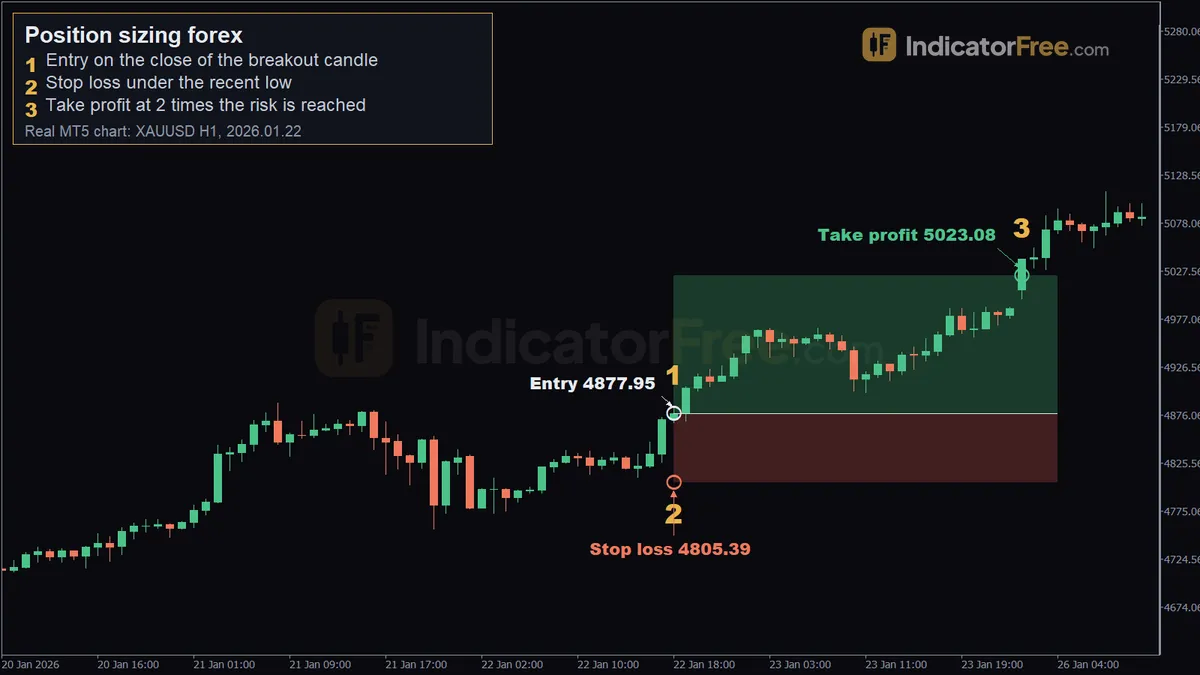 Real XAUUSD H1 chart from MetaTrader 5, a past example, not a forecast. 1 - entry on the close of the breakout candle; 2 - stop loss under the recent low; 3 - take profit at 2 times the risk is reached.
The chart above is a past example on gold, on the 1-hour chart, not a prediction. Marker 1 is the entry on the close of the breakout candle at 18:00 on 22 January 2026, at 4885.43. Marker 2 is the stop loss under the recent low, at 4805.39, set on that same 18:00 candle. Marker 3 shows price reaching the take profit at 2 times the risk at 01:00 on 26 January 2026, at 5040.08. The trade's stated price risk was 72.56. With the same illustrative 100-ounce contract, one lot loses 72.56 × 100 = $7,256 at the stop, so a $50 risk allows $50 ÷ $7,256 ≈ 0.0069 lots. That is below a 0.01 minimum lot, and 0.01 lots would risk $72.56, about 1.45% of $5,000. On this trade you either skip it or accept more risk than planned. Notice that no 10,000 appears anywhere: on gold, price distance × contract size does that job.
Position size table: six cases, one formula
Each row below uses the same formula. The last column is the raw result rounded down to a 0.01 lot step.
| Case | Account | Risk | Risk amount | Stop | Pip value per lot | Raw lots | Order |
|---|---|---|---|---|---|---|---|
| Base case, EUR/USD | $5,000 | 1% | $50 | 25 pips | $10 | 0.20 | 0.20 |
| Wider stop | $5,000 | 1% | $50 | 50 pips | $10 | 0.10 | 0.10 |
| Double the risk | $5,000 | 2% | $100 | 25 pips | $10 | 0.40 | 0.40 |
| USD/JPY at 125.00 | $5,000 | 1% | $50 | 25 pips | $8 | 0.25 | 0.25 |
| Small account | $500 | 1% | $5 | 30 pips | $10 | 0.0167 | 0.01 (risks $3) |
| Below the minimum | $200 | 1% | $2 | 40 pips | $10 | 0.005 | none at 1% (0.01 risks $4 = 2%) |
The bars below change only one input. The $50 risk stays fixed while the stop gets wider, and the size has to shrink in the same proportion.
Round down to your broker's lot limits
Every broker sets a minimum lot, a maximum lot and a lot step, which is the smallest amount a size can change by. You can't send a raw result like 0.0167 as an order. It has to be rounded to a valid size first.
The rule is to always round down. In the small-account row, 0.01 lots risks $3. Rounding up to 0.02 would risk 0.02 × $10 × 30 = $6, which is more than the $5 budget.
Sometimes the raw size is below the minimum lot, as in the last row. Then you have two honest choices:
- Skip the trade.
- Take the minimum lot knowingly. 0.01 lots × $10 × 40 pips = $4, which is 2% of that account, double the plan.
Don't move the stop closer just to make the numbers fit.
Leverage does not change your position size
The formula has no leverage term. Leverage decides how much margin you need, meaning the deposit your broker holds while the trade is open. Your stop distance and lot size decide how much you lose.
With the same example, 0.20 lots of EUR/USD is 20,000 euros. At the same 1.1000 entry, that is $22,000 of currency. With 100:1 leverage the broker holds $22,000 ÷ 100 = $220 as margin. With 500:1 it holds $44. Either way, the stop 25 pips away costs $50. The comparison below puts the two side by side.
- –0.20 lots, $22,000 of currency
- –Margin held: $220
- –Loss at the 25-pip stop: $50
- –0.20 lots, $22,000 of currency
- –Margin held: $44
- –Loss at the 25-pip stop: $50
Leverage only sets a ceiling on how large you could trade. High leverage lets an oversized trade through, but the damage comes from the size you choose.
If you're wondering which leverage suits a small account, the formula stays the same at any ratio; lower leverage only makes it harder to open an oversized trade by mistake.
Funded and prop accounts work the same way. Say you have a $10,000 account at 100:1. Your buying power is $1,000,000, but you size on the $10,000: 1% is $100, not $10,000.
Adjust size for volatility and for trades already open
Volatility. When the market moves more, a sensible stop sits further away, so the formula gives a smaller size on its own. Many traders set the stop as a multiple of the Average True Range (ATR), an indicator that measures the average size of recent candles. For example, if ATR reads 20 pips and you use 1.5 × ATR, the stop is 30 pips. Then $50 ÷ (30 × $10) = 0.1667, which rounds down to 0.16 lots and risks $48.
Total open risk. Your risk percentage applies to each trade, but losses add up across every open position. Three trades at 1% each lose 3% together if all three stops are hit. If those trades are long EUR/USD, long GBP/USD and short USD/CHF, they are mostly one bet against the dollar. The bar below stacks them.
Set a ceiling for combined open risk in your trading plan, before any trade. If your open risk plus the new trade would go over that ceiling, cut the new size or skip the trade.
A shortcut so fast entries don't outrun your maths
On a 1-minute or 5-minute chart, price can move away while you're still calculating. The fix is to do the maths before the session starts.
For a USD-quoted pair and a dollar account, the formula reduces to: lots = (risk amount ÷ 10) ÷ stop pips. With the same $50 risk, that's lots = 5 ÷ stop pips. A 10-pip stop gives 0.50 lots, a 5-pip stop gives 1.00 lot, and an 8-pip stop gives 0.625, rounded down to 0.62.
Work out your own version of that line for your balance and risk. Add the lot sizes for the stop distances you use most, and keep the list next to your screen. Redo it at the start of each week and after any large win or loss.
What a losing streak does at 1%, 5% and 10% risk
How long you survive a bad run depends on your risk percentage, not only on your strategy. The maths below starts from the same $5,000 and assumes 10 losing trades in a row. Each loss takes the full risk percentage of the current balance. This is arithmetic only and says nothing about how often any real strategy loses.
- At 1%: $5,000 × 0.99^10 ≈ $4,522. You need about +10.6% to get back to $5,000.
- At 5%: $5,000 × 0.95^10 ≈ $2,994. You need about +67%.
- At 10%: $5,000 × 0.90^10 ≈ $1,743. You need about +187%.
This is the idea behind risk of ruin: the chance that a run of losses shrinks the account to a level it can't realistically recover from. Keeping risk per trade small and fixed keeps that run survivable.
Position sizing mistakes that blow accounts
- Trading the same lot every time. 0.50 lots on a 10-pip stop risks $50. The same 0.50 lots on a 100-pip stop risks $500, ten times as much.
- Widening the stop after entry. If you move a 25-pip stop out to 50 pips at 0.20 lots, the loss doubles to $100. If the stop really needed that room, the size should have been smaller from the start.
- Sizing on buying power. Treating the leveraged figure as your balance makes every trade a hundred times too big at 100:1.
- Rounding up. Always round down, as shown in the rounding section.
- Assuming $10 a pip everywhere. On yen pairs, gold or a non-dollar account, the pip value is different. Using $10 there gives the wrong size.
- Ignoring stacked trades. Several 1% trades on related pairs can become one large loss.
- Raising risk to win it back. After a few losses, a bigger percentage pushes you down the faster curves above. Keep the percentage the same and let the size shrink with your balance.
Checklist before you send the order
- Put the stop at the level that proves the idea wrong.
- Measure the stop distance in pips (or price).
- Check the pip value for this symbol in your account currency.
- Lots = risk amount ÷ (stop distance × pip value per lot).
- Round down to the lot step and stay within the broker's minimum and maximum lot.
- Check: lots × pip value × stop pips = your risk amount.
- Confirm that total open risk, including this trade, is still under your ceiling.
- Type both the lot size and the stop loss into the order window before you send the order; once it fills, the stop sits on the broker's side and closes the trade automatically if price reaches it.
FAQ
Should I size on my balance or my equity when trades are open?
Balance is your account value without open trades. Equity also counts the floating profit or loss on trades that are still open. If some open trades are losing, equity is lower than balance. Sizing on the lower of the two keeps you from risking money that is already partly lost.
Does the spread count as part of my stop distance?
Yes. A buy fills at the ask price, but the stop is triggered by the bid price, so the spread adds to your real loss. With the same example, a 25-pip stop plus a 1-pip spread is a 26-pip loss, so size on 26 pips: $50 ÷ (26 × $10) = $50 ÷ $260 = 0.192, rounded down to 0.19 lots.
How do I size a trade if my account is in euros or pounds?
Your risk amount is in your account currency, so the pip value has to be in that currency too. Say EUR/USD trades at 1.2500. Then $10 per pip is $10 ÷ 1.25 = €8 per pip per lot. On a €5,000 account at 1% with a 25-pip stop: €50 ÷ (25 × €8) = 0.25 lots.
What risk percentage per trade should I use?
There is no single correct number. Choose your risk per trade against your account size and your wider financial situation, and write it into your trading plan before you trade. Don't decide it fresh on each trade. The losing-streak maths above shows how quickly larger percentages compound against you.
Part of Risk & money management: more guides, terms and free tools on this subject.