Position sizing
Also called position size calculation, trade sizing, lot sizing, risk-based sizing
Position sizing is the calculation that decides how many lots, shares or contracts you trade, so that being stopped out costs a fixed, pre-chosen part of your account.
Position sizing means choosing how many lots to trade so that, if your stop is hit, you lose a set amount you picked in advance, such as 1% of your account. You work it out from three things: your account size, your stop distance and the pip value. Get the size wrong and a normal run of losing trades can wipe out the account.
How much of your account to risk per trade
Choose the risk % before you look at lots. A small fixed figure such as 1% keeps a losing run survivable. Ten losses in a row at 1% leave 0.99^10 ≈ 90.4% of the account, while at 5% they leave 0.95^10 ≈ 59.9%. You can redo this for any risk figure: (1 − risk %) raised to the number of losses.
Use this test: if ten losses in a row at your chosen risk would leave less of the account than you could keep trading with calmly, lower the risk % until it would not. Set the figure once and keep it. Never raise it during a losing run to win the money back.
The position sizing formula
You need three inputs: the money you accept losing, the distance to your stop, and the pip value (what one pip of movement is worth for one lot).
Money at risk = Account balance × Risk %
Position size (lots) = Money at risk ÷ (Stop distance in pips × Pip value per lot)
A pip is the 4th decimal on most pairs, 0.0001 on EURUSD. On a pair quoted in USD, such as EURUSD, with an account in USD, one standard lot is 100,000 units and one pip is worth $10. A mini lot (10,000 units) is worth $1 per pip and a micro lot (1,000 units) $0.10.
The order of work matters. Pick the stop from the chart first, then let the formula give the size, never the other way round:
- Choose your risk %.
- Place the stop at the level the chart gives you.
- Measure the distance from entry to stop in pips.
- Work out the lots with the formula and round down to your broker's smallest step.
- Before you confirm, multiply lots × stop pips × pip value. The volume field of the order window shows size, not risk, so if the result is not your planned figure, the size is wrong.
Worked sizing on a $500 and a $5,000 account
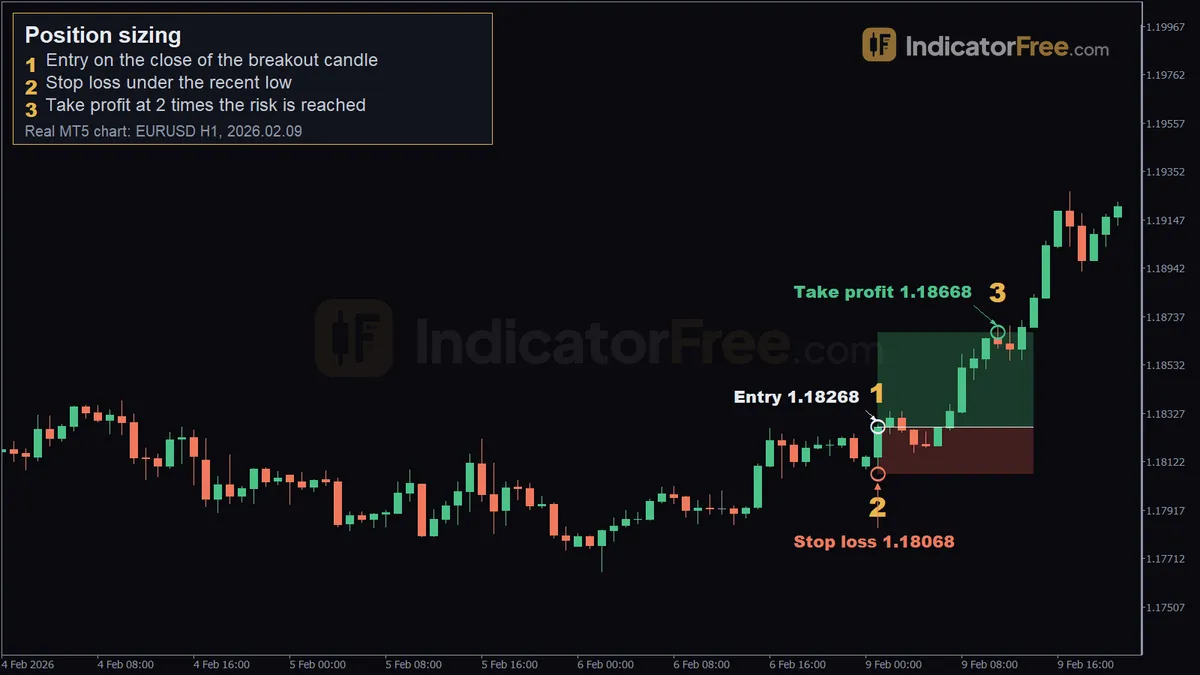
The figures below are an illustrative example: you risk 1% per trade and buy EURUSD with a stop 20 pips below entry. The chart at the top of this page shows this kind of setup: the stop sits under the recent low, 20 pips from entry.
One lot stopped out at 20 pips loses 20 × $10 = $200. That number is the divisor for every account.
$500 account. Risk: $500 × 1% = $5. Size: $5 ÷ $200 = 0.025 lots. If your broker's smallest step is 0.01 lots, round down to 0.02. Real risk: 0.02 × $200 = $4.
The calculation below lays out the same steps for a $5,000 account.
Why a wider stop means fewer lots
The money at risk stays fixed, so the size must shrink as the stop grows. The chart below shows the $5,000 account at 1% risk with four stop distances.
Each bar loses the same $50 if the stop is hit. A trader who uses 0.25 lots on every trade risks $25 with a 10-pip stop and $250 with a 100-pip stop without noticing.
Quick-reference lot sizes at 1% risk
Same illustrative setup: a USD-quoted pair at $10 per pip per standard lot, with 0.01 lots as the smallest size.
| Account | Money at risk | 10-pip stop | 20-pip stop | 50-pip stop | 100-pip stop |
|---|---|---|---|---|---|
| $10,000 | $100 | 1.00 lots | 0.50 lots | 0.20 lots | 0.10 lots |
| $50,000 | $500 | 5.00 lots | 2.50 lots | 1.00 lots | 0.50 lots |
Decision rule: if the formula gives less than the smallest size your broker allows, skip the trade. The $500 account from the worked example is that case with a 100-pip stop: $5 of risk would need 0.005 lots. Do not tighten the stop to make it fit.
Sizing a pair not quoted in USD: a USDJPY example
When the quote currency (the second currency in the pair) is not your account currency, the pip value is not $10 and has to be worked out. Pip value per lot = pip size × contract size, which gives an amount in the quote currency; then convert it to your account currency at the current rate. On yen pairs the pip is the 2nd decimal, 0.01.
Illustrative example: a $10,000 account risks 1% ($100) on USDJPY with a 20-pip stop, and the rate is taken as 150.00 only to show the steps.
So the same $10,000 account with the same 20-pip stop trades 0.75 lots on USDJPY instead of the 0.50 lots in the EURUSD table.
Sizing stocks, crypto, futures and options
The logic is the same in every market. Only the unit changes.
- Stocks and crypto: units = money at risk ÷ the distance between entry and stop, which works for long and short trades. Illustrative: $50 risk ÷ $2 stop distance = 25 shares. Crypto can be bought in fractions; still round down to the smallest step the exchange allows.
- Futures: contracts = money at risk ÷ (stop distance in ticks × tick value). A tick is the smallest price step the contract can move, and the tick value is what one tick is worth per contract. You can only trade whole contracts. If one contract risks more than your budget, skip the trade or use a smaller (micro) contract if the market has one.
- Options you buy: the premium is the most you can lose, so contracts = money at risk ÷ premium cost of one contract.
Sizing mistakes that cost the most
- Sizing from the balance while other trades are still open. The balance ignores open losses and the risk already running. Size the new trade from your equity (your balance plus or minus the profit or loss on open trades), and count the open risk in your total.
- Rounding up. Any size above the formula's result risks more than you planned, and on a small account one 0.01 step is a large share of the risk. Always round down.
- Using $10 per pip on everything. Pairs not quoted in USD, gold and indices have other values. Work the pip value out first, as in the USDJPY example above.
- Counting related trades separately. Two trades at 1% each in pairs that move together behave like one 2% position.
- Treating the result as exact. Spread (the gap between the buy and sell price) and slippage (a fill at a worse price than your order asked for) add to the loss, and a price gap can jump past the stop.
FAQ
What is the maximum position size I can open?
The ceiling comes from margin: the broker rejects an order when your free margin (the equity not already held as margin by open trades) cannot cover it, and some also cap the lots per order. That ceiling is not a target. A risk-based size normally sits far below it.
Does higher leverage mean I should trade bigger?
No. Leverage changes how much margin is held, not what a pip costs you. In the example above, 0.25 lots with a 20-pip stop loses $50 at any leverage. Leverage limits size in one case only: with low leverage or a small account, the margin needed for the risk-based size can exceed your free margin, and then you trade smaller or skip.
Should I recalculate the size after every trade?
Yes, from your current equity. After losses the size shrinks and slows the drawdown; after wins it grows with the account.
Can position sizing make a losing strategy profitable?
No. It controls how fast the account moves, not which direction. It decides whether you survive a losing run long enough for the strategy's results to show.