Drawdown limit
Also called Maximum drawdown limit, Max drawdown limit, Daily drawdown limit, Daily loss limit, Drawdown cap, DD limit
A drawdown limit is the largest fall in account value you allow, in percent or money, before you stop trading or cut size. It can cover the whole account (maximum drawdown limit) or a single day (daily drawdown limit).
The deeper the hole, the harder the climb. After a 10% loss you need an 11.1% gain to get back to where you started. After a 50% loss you need 100%. A drawdown limit stops you while the climb back is still small.
If you trade a funded or evaluation account from a prop firm, the drawdown limit is not something you choose. The provider sets it, and breaking it can fail the evaluation or close the account. These rules usually come in two parts, a daily limit and a maximum limit. The details below decide where your floor really sits: whether the limit uses balance or equity, and whether it is static or trailing. On a personal account, you set the limit yourself.
The drawdown limit formula
Equity is your balance plus or minus the result of trades that are still open. The reference balance is the figure the fall is measured from, and it changes with the type of limit.
The formula uses both terms in three steps. The numbers come from the illustrative $5,000 account with a 10% limit used further down:
- Limit in money = reference balance × limit %. Here $5,000 × 10% = $500.
- Account floor = reference balance − limit in money. Here $5,000 − $500 = $4,500.
- Current drawdown % = (reference balance − current equity) ÷ reference balance × 100. If equity is $4,800, that is $200 ÷ $5,000 × 100 = 4%.
Most rule sets use both: a small daily limit inside a larger overall one.
For a daily limit, the reference is taken at the start of the trading day, so the daily floor moves every day. For example, if a $5,000 account starts the day at $5,200, a 4% daily limit is $208 and the daily floor is $4,992. Rules differ on which figure they use. Some take the starting balance. Others take the higher of balance or equity at the reset, so a trade that is in profit overnight raises that day's floor.
Then check what the limit is measured against. If it is measured against equity, as many funded-account rules are, a floating loss counts toward the daily limit while the trade is still open. On that $5,200 day, an open trade down $210 takes equity to $4,990, below the $4,992 floor, before a single trade is closed.
Static or trailing: know which floor you are standing on
A static limit measures from your starting balance, so the floor never moves. A trailing limit measures from the highest point the account has reached, so the floor climbs as you make money.
The chart below shows why this matters. An account starts at $5,000 with a 10% limit and grows to $5,600. The static floor stays at $4,500. The trailing floor has moved up to $5,040, so a pullback to $5,040 hits the limit while you are still $40 above your starting balance, marked by the grey dashed line.
Some rules trail by a fixed money amount instead: 10% of the starting balance, here $500, which puts the floor at $5,100 at the $5,600 peak rather than $5,040. Check which one your rule uses, and whether the peak is counted on balance or equity. If the peak is counted on equity, a profit you never closed still lifts the floor. A floating loss then counts against that higher floor just as a closed loss does.
The last question is whether the trailing stops. Some trailing rules lock the floor once it reaches the starting balance, and from then on it behaves like a static limit. Others keep trailing with every new peak. The chart shows a rule that keeps trailing. With a lock at the starting balance, the floor would have stopped at $5,000, so the pullback to $5,040 would still leave $40 of room. Under the fixed-amount version, the lock comes at a $5,500 peak.
Worked calculations for 500, 5,000 and 50,000 USD accounts
The figures here are an illustrative example: a static 10% maximum limit, a 4% daily limit and 1% risk per trade. The calculation below shows the steps for a $5,000 account.
The table applies the same steps to all three account sizes.
| Account | 10% maximum limit | Floor | 4% daily limit | 1% risk per trade | Full losses to the daily limit |
|---|---|---|---|---|---|
| $500 | $50 | $450 | $20 | $5 | 4 |
| $5,000 | $500 | $4,500 | $200 | $50 | 4 |
| $50,000 | $5,000 | $45,000 | $2,000 | $500 | 4 |
The money changes with the account, but the count does not. That gives you a rule you can copy:
Full losses to the limit = Limit % ÷ Risk per trade %
Here that is 4 losses for the day and 10 for the account, assuming risk stays fixed in money at 1% of the starting balance; if you recalculate 1% of the shrinking balance, the count is slightly higher. If the answer is smaller than a losing streak you have already lived through, lower your risk per trade.
To choose the limit itself, work the other way round. Start from the longest losing streak you have had, or that your backtest shows, at your usual risk per trade:
Limit % = Longest past losing streak × Risk per trade % × Safety factor
In the same illustrative example, a longest streak of 6 losses at 1% risk with a safety factor of 1.5 gives 6 × 1% × 1.5 = 9%. Round it to a figure you can remember, such as 10%, and keep it fixed. If the result is more than you can afford to lose, cut the risk per trade, not the safety factor.
Checking a limit against a real backtest
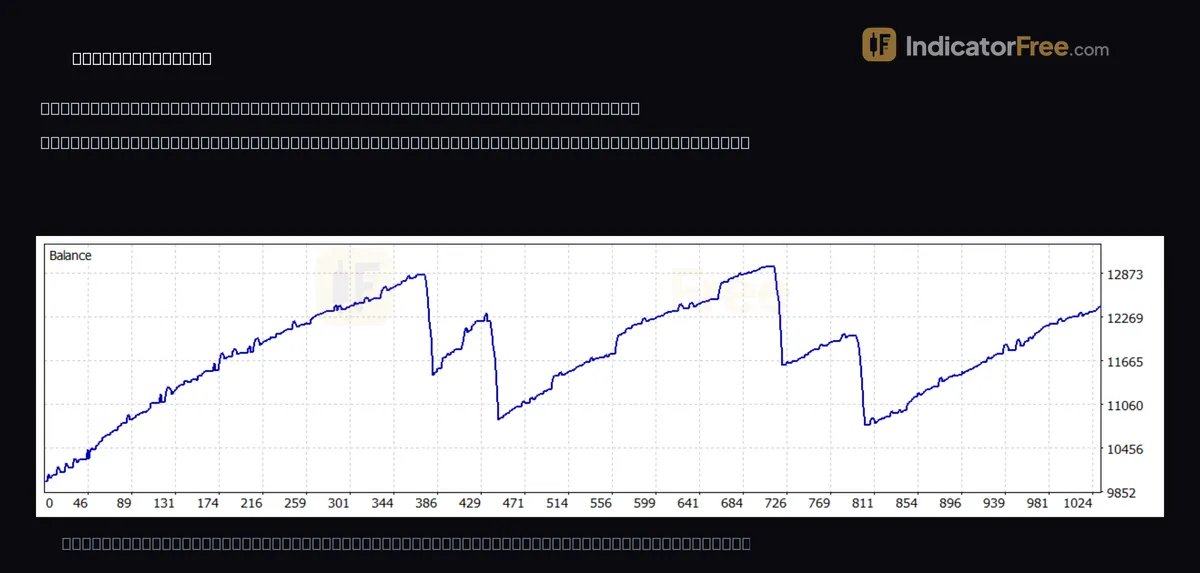
A limit only works if your strategy can stay inside it. Here is a past example from a six-month backtest of an automated strategy on XAUUSD, the symbol for gold priced in US dollars. It ran on the 15-minute chart from 26 March to 26 September 2026 and placed 514 trades. Its maximum equity drawdown was 2,508.26 (19.32%) and its maximum balance drawdown was 2,189.79 (16.89%). This is past data, not a forecast.
That test tells you two things:
- A 10% limit would have been broken in that test. As a rough guide, halving the position size halves the drawdown, to about 9.66%, which still leaves almost no room. Copy this rule: size factor = your limit ÷ past maximum equity drawdown, then add a safety margin. Here 10 ÷ 19.32 ≈ 0.52 only just touches the limit, so use well under half size, for example a quarter size for about 4.83%.
- The equity figure is 318.47 larger than the balance figure in account currency, or 19.32% against 16.89%. Open losses made the fall deeper than closed trades alone showed. Always test your limit against the equity drawdown, not the balance drawdown.
Decision rule: if the largest past equity drawdown is above your limit, cut size until it sits well below it, or do not trade that strategy on that account.
Mistakes that break a drawdown limit
- Calling a floating loss "not real yet". An open loss counts toward an equity-based limit as soon as it appears. Holding a losing trade and hoping it comes back uses up the room you have left.
- Adding to a losing trade near the floor. A second position on the same losing idea doubles your risk just when you have the least room left. One more move against you can break the limit.
- Sizing trades without the limit in mind. Large risk per trade leaves room for only two or three losses.
- Forgetting costs and gaps. Spread, commission, swap and slippage can push a loss past the planned amount.
- Moving the limit after it is hit. A limit you can move in the moment does not protect you.
How to enforce the limit on your own account
Your platform's account history or trading report shows the largest drawdown so far, in money and percent. To enforce a limit on a personal account, write the floor in money and set an equity alert near it. If you run an automated strategy that has an equity stop or a maximum drawdown input, set it to the same floor.
FAQ
Does a drawdown limit close my trades automatically?
Only if something enforces it. A funded or evaluation account has daily and maximum loss levels fixed by the provider and usually shown on the account dashboard. In copy trading, the limit is normally a setting on each account you copy: when your copied equity falls by the amount you chose, copying stops. An automated strategy may have its own equity stop. A personal limit is a rule you carry out yourself. It is also separate from the broker's stop out, which is triggered by margin level.
What should I do after I hit my daily drawdown limit?
Close the platform for the day. Before the next session, check whether the losses followed your plan or broke it. Losses that followed the plan point to position size or market conditions. Losses that broke it point to discipline.
When does a daily drawdown limit reset?
It resets at the start of the provider's trading day, which may not match midnight where you live. Check the reset time and whether the day's starting figure is taken from balance or equity, because open trades carried overnight change the answer.