ATR stop loss
Also called ATR stop, volatility stop, ATR-based stop loss, ATR trailing stop
An ATR stop loss is a stop placed a set multiple of the Average True Range (ATR) away from your entry. The stop moves further from your entry when the market is volatile and closer when it is quiet.
A fixed stop does not change when the market speeds up or slows down. In the IndicatorFree Lab's EURUSD 1-hour data from 2025-10-02 to 2026-10-02, the average candle measured 17.8 pips in the London/New York overlap. In Asian hours it measured 8.8 pips (past data, not a forecast). So a 15-pip stop with plenty of room at night can be hit by an ordinary afternoon candle.
The ATR stop loss formula, line by line
Buy:  stop = entry − (ATR × multiplier)
Sell: stop = entry + (ATR × multiplier)
Lot size = risk in money ÷ (stop in pips × pip value per lot)
ATR (Average True Range) is the average size of recent candles, including gaps, usually measured over 14 candles. The multiplier decides how many normal-sized candles can go against you before the stop is hit. Always read ATR on the timeframe you trade.
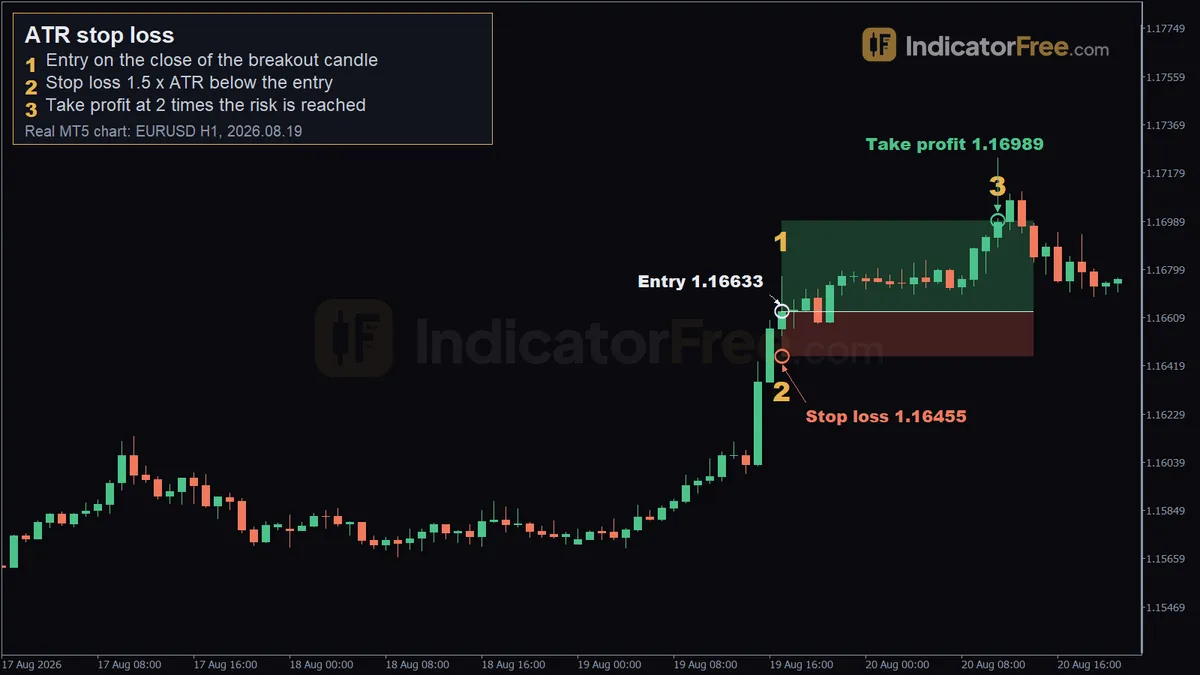
The chart at the top shows a past EURUSD 1-hour buy. It is not a prediction. You buy on the close of the breakout candle (2026.08.19, 17:00). The numbered markers point to the candles. The prices below are the trade's own levels. The entry was 1.16633 and ATR was about 12 pips. 1.5 × ATR put the stop 17.8 pips below, at 1.16455 (about 18 pips). The take profit at twice that risk, 1.16989, was reached on 2026.08.20 at 11:00.
Sizing the position once the ATR stop is set
The ATR decides how far away the stop is. Your lot size decides how much money that distance costs. Keep your risk as a fixed percentage and change the lot size to fit the stop.
The numbers below are an illustrative example. You buy EURUSD with ATR at 10 pips and a multiplier of 2, so the stop is 20 pips away. You risk 1% of the account. One standard lot (100,000 units) on a USD-quoted pair is worth $10 per pip.
The calculation below shows the $5,000 case step by step.
Quick reference: lots for each account and ATR stop
This table uses the same example: 1% risk, $10 per pip per standard lot, and lots rounded down to 0.01.
| Account | 1% risk | 20-pip stop | 30-pip stop | 40-pip stop |
|---|---|---|---|---|
| $500 | $5 | 0.02 lots | 0.01 lots | 0.01 lots |
| $5,000 | $50 | 0.25 lots | 0.16 lots | 0.12 lots |
| $50,000 | $500 | 2.50 lots | 1.66 lots | 1.25 lots |
On the $500 row, 0.025 lots rounds down to 0.02, so your real risk at 20 pips is $4.
The rule to remember is this: when ATR doubles, your lot size halves. The amount of money you risk stays the same.
Choosing a multiplier that matches the market right now
- 1 × ATR: one normal candle can reach your stop. Use it only when you have a clear reason for a very tight stop.
- 1.5 to 2 × ATR: gives room for a couple of normal candles against you. On EURUSD 1-hour, 1.5 × the median ATR (10.9 pips) is about 16 pips, which is less than one average overlap candle (17.8 pips). If you trade the overlap, start at 2 ×.
- 3 × ATR: wide enough to stay in a trend. It is mostly used for trailing stops.
The Lab's EURUSD 1-hour figures give you a yardstick. ATR(14) averaged 11.7 pips. Half of the candles had ATR below 10.9 pips, and the highest 10% were above 16.2 pips (2025-10-02 to 2026-10-02, past data, not a forecast). If 1-hour ATR is above 16.2 pips, check for news first. Keep your % risk fixed or lower it; never keep the old lot size.
Watch out for a common misread. A 14-candle ATR on a 1-hour chart covers about 14 hours, so it mixes quiet and busy sessions. The bars below show how much candle size changed during the day.
At 15:00 server time, your 14-hour ATR is built mostly from Asian and London-morning candles (8.8 and 13.1 pips on average), while overlap candles average 17.8 pips. So use the top of your multiplier range.
On gold, the Lab's XAUUSD 1-hour ATR(14) averaged $21.9 over the same period. That means a 1.5 × ATR stop was about $33 of price movement. Gold's ATR is in dollars per ounce, not pips, so check your contract size before you use the lot formula above.
Trailing an ATR stop as the trade moves
A trailing stop follows price when the trade moves your way and never moves back. To trail a buy with ATR, take the highest high since entry and subtract the multiplier × ATR. Recalculate after each candle closes, and only ever move the stop up. For a sell, do the mirror image.
The chart below shows the stop stepping up after each new high, staying put on pullbacks, and the exit on the candle that falls through it.
The built-in trailing stop on most platforms keeps a fixed distance in points. To trail by ATR, you usually move the stop by hand at each close or use an automated script.
Mistakes that break an ATR stop
- Using a wider stop with the same lot size. A bigger ATR stop without a smaller lot just means a bigger loss.
- Reading ATR in the wrong units. ATR is shown in price. On EURUSD, 0.00120 means 12 pips. On gold, the value is in dollars. If the order window asks for the distance in points, 18 pips is 180 points on a five-decimal quote.
- Taking ATR from another timeframe. On EURUSD, 4-hour ATR(14) averaged 24.1 pips against 11.7 pips on the 1-hour chart (Lab, Oct 2025 to Oct 2026, past data, not a forecast). A 1.5 × ATR stop taken from the wrong chart is about 36 pips instead of about 18.
- Pushing the stop further away after entry. Rising ATR after you enter is not a reason to widen your risk.
- Forgetting the spread on sells. A sell's stop is triggered by the ask price, so add the spread to the ATR distance.
FAQ
What [ATR period](/glossary/atr-period) should I use for a [stop loss](/glossary/stop-loss)?
The 14-candle setting used on this page is the common choice. A shorter period reacts faster to a sudden spike. A longer one is smoother but slower to notice that the market has changed pace.
Should my take profit also be based on ATR?
It can be. The chart example set the take profit at twice the risk, so the target was tied to ATR through the stop. That keeps your reward-to-risk ratio the same whether the market is quiet or busy.
What do I do if the ATR stop is too wide for my smallest lot size?
Look at the $500 row: 30-pip and 40-pip stops both give 0.01 lots, so your real risk is $3 and $4, not $5. Beyond 50 pips, even 0.01 lots risks more than 1%. Then skip the trade or trade a lower timeframe whose ATR fits. Do not shrink the multiplier just to make the stop fit.