ATR multiplier
Also called ATR multiple, ATR factor, ATR stop multiplier
An ATR multiplier is the number you multiply the Average True Range (ATR) by to set a distance on the chart. It is used most often for a stop loss: 1.5 × an ATR of 10 pips gives a 15-pip stop.
The multiplier sets how much normal price movement your stop can survive. Through position size, it also sets how many lots you can trade for the same dollar risk. So choose the multiplier first and size the trade second. If you pick the lot size first and then squeeze the stop to fit, the stop ends up inside normal noise.
The ATR multiplier formula, and what 1 ATR means
Stop distance = ATR × multiplier
Lot size = Risk in money ÷ (Stop distance in pips × pip value of 1 lot)
1 ATR is the average size of one candle on your chart, measured over recent candles. A 14-candle period is the usual choice. It is in pips on currency pairs and in dollars on gold. The IndicatorFree Lab measured EURUSD 1-hour data from 2025-10-02 to 2026-10-02 (past data, not a forecast). ATR(14) averaged 11.7 pips, and half of the candles had an ATR below 10.9 pips. On XAUUSD 1-hour over the same period, ATR(14) averaged 21.9 $.
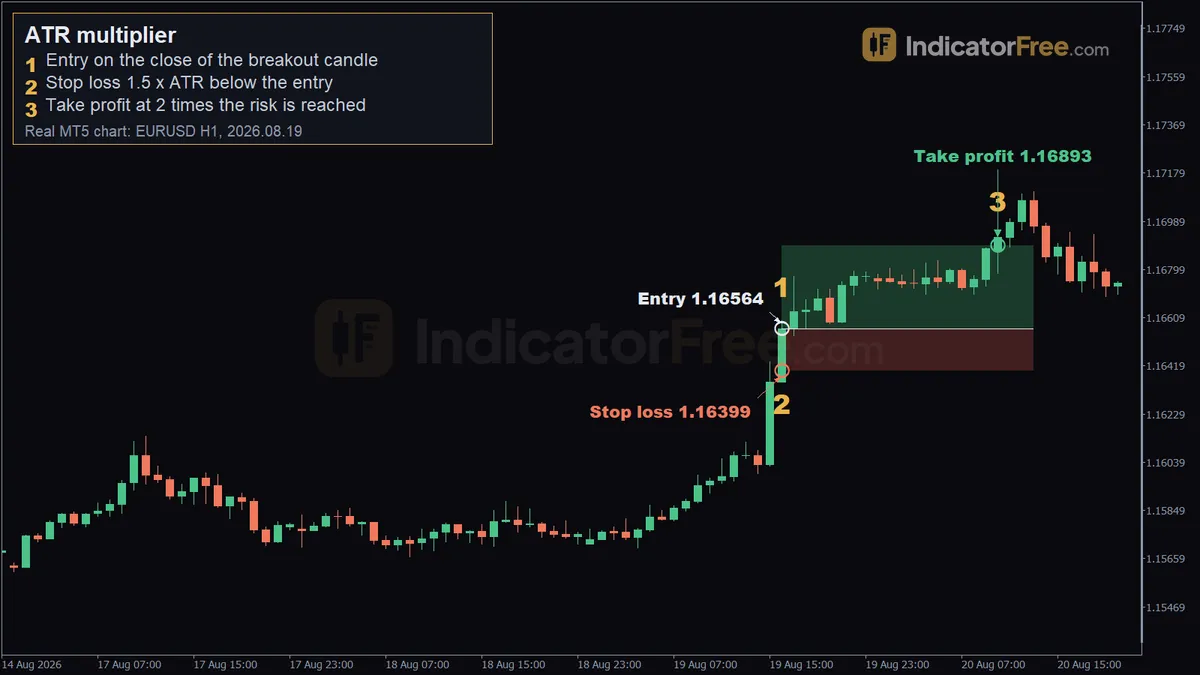
The chart at the top of this page is a past example, not a prediction. On EURUSD 1-hour, the buy was entered on the close of the breakout candle at 2026.08.19 16:00. The entry marker on the chart sits at that close, 1.16596. The stop and target in this example are measured from the recorded entry price of 1.16564. ATR was 11 pips, so 1.5 × ATR = 16.5 pips put the stop at 1.16399. The take profit at 1.16893 was set at 2 times the risk (about 33 pips) and was reached on 2026.08.20 10:00.
Why a 1× ATR stop gets hit by normal noise
A stop at exactly 1 ATR sits inside one ordinary candle's range. Any routine pullback can reach it. In the chart below, two candles after the buy, a dip to 1.0986 hits the 1× stop at 1.0990. The 2× stop at 1.0980 is never touched, and price closes 21 pips above the entry.
A wider stop does not mean more risk in money, as long as you cut the lot size to match. The next section shows how.
Sizing a trade from the ATR multiplier: 500, 5,000 and 50,000 USD
The figures here are an illustrative example. You buy EURUSD with ATR at 10 pips, use a multiplier of 2, and risk 1% of the account. On a USD-quoted pair, 1 standard lot (100,000 units) is worth $10 per pip, 1 mini lot (10,000 units) $1, and 1 micro lot (1,000 units) $0.10.
First, the stop distance: 10 pips × 2 = 20 pips. Then size each account:
- $500 account: risk = $5. Lots = $5 ÷ (20 × $10) = 0.025. Round down to 0.02 lots. Your real risk is then 20 pips × $0.20 = $4.
- $5,000 account: risk = $50. Lots = $50 ÷ (20 × $10) = 0.25 lots.
- $50,000 account: risk = $500. Lots = $500 ÷ (20 × $10) = 2.50 lots.
Quick-reference table: lot size by multiplier and account size
This uses the same example: ATR 10 pips, 1% risk, $10 per pip per standard lot, rounded down to 0.01 lots.
| Multiplier | Stop distance | $500 account | $5,000 account | $50,000 account |
|---|---|---|---|---|
| 1× | 10 pips | 0.05 lots | 0.50 lots | 5.00 lots |
| 1.5× | 15 pips | 0.03 lots | 0.33 lots | 3.33 lots |
| 2× | 20 pips | 0.02 lots | 0.25 lots | 2.50 lots |
| 3× | 30 pips | 0.01 lots | 0.16 lots | 1.66 lots |
When the multiplier doubles, the lot size halves. The dollar risk stays the same. On small accounts, rounding down to 0.01 lots makes the real risk a little lower than planned.
Choosing an ATR multiplier for day trading and swing trading
ATR(14) on a 1-hour chart blends 14 hours of quiet and busy trading. The Lab's EURUSD 1-hour data shows how much a single hour's range depends on the session (past data, not a forecast):
The average 1-hour range during the overlap (17.8 pips) was larger than the average ATR (11.7 pips). Session times are in broker server time. Use these rules:
- If you enter during the overlap, use 2× ATR or more. At the average ATR of 11.7 pips, 1.5× is 17.55 pips, which only just matches one average overlap candle.
- If you trade quiet hours with a tight target, 1× to 1.5× can fit. Recheck it once the busy session opens.
- If you hold trades for days or trail a stop, 2× to 3× ATR on a 4-hour or daily chart leaves room for swings.
- If the stop at your chosen multiplier needs less than 0.01 lots at your risk %, skip the trade. Do not raise your risk.
ATR multiplier mistakes that quietly double your risk
- Keeping the same lot size when you widen the multiplier. Moving from 1× to 2× with a fixed lot size doubles your dollar risk.
- Reading ATR from the wrong timeframe. On EURUSD, the Lab found a 4-hour ATR(14) average of 24.1 pips against 11.7 pips on the 1-hour (past data). A 4-hour ATR on a 1-hour entry gives you a stop about twice as wide as you planned.
- Confusing points with pips. On a 5-digit quote, an ATR reading of 0.00110 is 11 pips. If you call that 110 pips, your lot size comes out ten times too small. If you go the other way, it comes out ten times too big.
- Ignoring high-volatility spells. On EURUSD 1-hour, the highest 10% of candles had an ATR above 16.2 pips. At 1.5×, that is a stop of more than 24 pips, so recalculate the lot size every time.
- Using the multiplier on gold as if it were in pips. XAUUSD ATR is in dollars. 1.5 × 21.9 $ is a stop distance of 32.85 $ in price. Put 32.85 $ into a pip-based lot formula and your size is wrong. Use the dollar value per 1.00 move per lot on gold instead.
When an indicator's ATR multiplier setting changes its signals
Add the ATR indicator, read its current value, multiply, and type the stop price into the order window.
Many tools have the multiplier built in as an input, often called "multiplier", "factor" or "ATR multiple". Examples include ATR trailing stops, channel indicators and trend-following overlays. Changing that one number moves every line the tool draws, so check it before you trust a signal.
FAQ
Should my take profit use an ATR multiplier too?
You can. Many traders set the target as a multiple of the stop instead, as in the 1:2 example at the top of the page. That keeps the reward-to-risk ratio fixed whatever ATR is doing.
Should I update the ATR multiplier stop while the trade is open?
For a fixed stop, no. Set it once at entry. For a trailing stop, recalculate ATR × multiplier on each closed candle, and only move the stop in your favour.
Which ATR period should I pair with the multiplier?
A shorter period reacts faster to sudden volatility but jumps around more. Your stop distance and lot size then change more from one trade to the next. Whichever you pick, keep the period and the multiplier fixed while you test a method.