Break-even stop
Also called Breakeven stop, Stop to break-even, BE, Stop moved to entry
A break-even stop is a stop-loss you move to your entry price after a trade has gone far enough in your favour. If price then turns back, the trade closes at about zero instead of at a loss.
Once you make the move, the money at risk on that trade drops to about zero. The trade-off is room. Your stop now sits much closer to the market, so an ordinary pullback can close a trade that would have reached its target.
Break-even is measured in R and is rarely exactly zero
Traders measure when to move the stop in R. R is the distance from your entry to your first stop. "Move at 1R" means price has travelled one full stop distance in your favour.
"Break-even" describes price, not money. Commission, swap and slippage still apply. So a stop placed exactly at your entry often shows a small loss on your statement.
Working out a break-even stop that covers your costs
The figures in this section are an illustrative example. You buy 0.10 lot of EURUSD (10,000 units), so one pip is worth $1. Your entry is 1.1000, your stop is 1.0980 (20 pips), and the broker charges $0.70 commission for the round trip.
Price reaches 1.1020, which is 1R, and you move the stop. If the stop sits exactly at entry and price reverses, you exit at 0 pips and still pay the $0.70. Put the stop one pip past entry instead, at 1.1001, and the same reversal ends slightly positive. The calculation below shows each step.
You can reuse this rule on your own trades, buy or sell: buffer in pips = round-trip cost in money ÷ pip value, rounded up.
On a sell, your stop is triggered by the ask price, which sits one spread above the chart price. So a sell can be stopped at break-even while the chart line has not quite reached your entry. Allow for this when you judge how much room the trade has.
Swap is charged or paid for each night the position stays open, whatever price you exit at. Swap can also be a credit, which lowers your cost. On a trade you hold for several days, add the expected swap to the cost (or subtract it if it is a credit) before you work out the buffer.
A real break-even trade on EURUSD
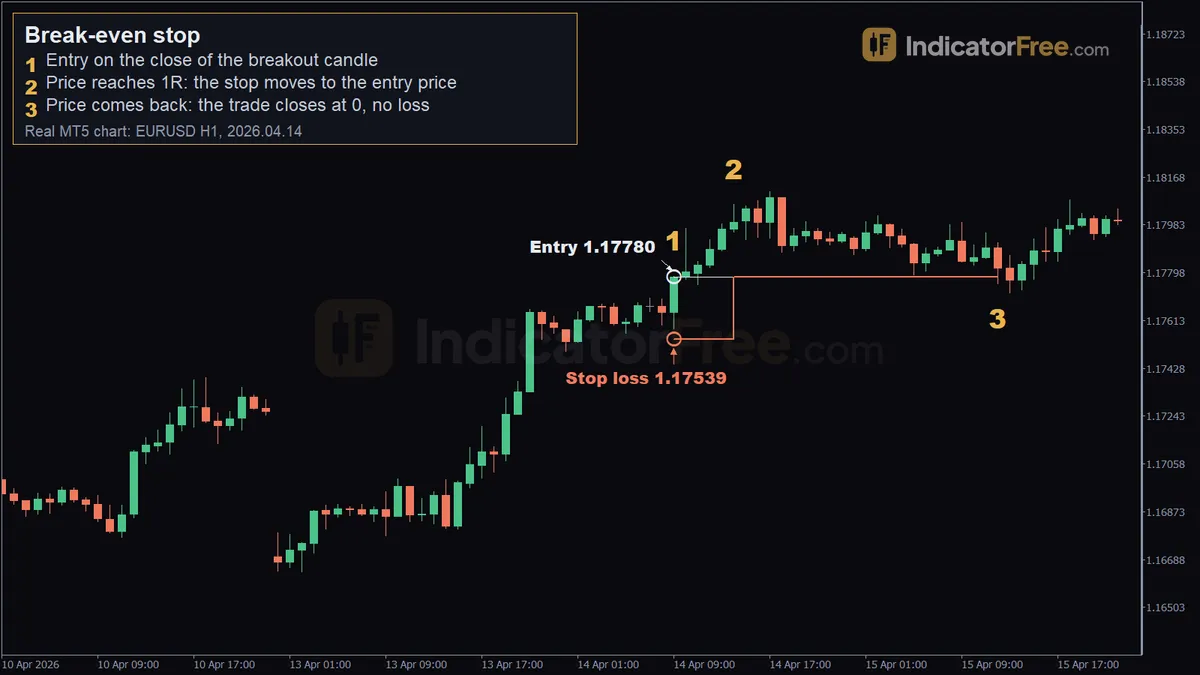
The 1-hour EURUSD chart at the top of this page shows a past trade, not a prediction. The buy opened at 1.17780 on 14 April 2026 at 09:00 with its first stop at 1.17539. That is 24.1 pips of risk (1.17780 − 1.17539 = 0.00241).
At 14:00 the same day, price reached 1.18021, exactly 1R (1.17780 + 0.00241). The stop moved up to the entry price. Price then came back down, and the trade closed on 15 April 2026 at 12:00 at 1.17780, with nothing lost on price.
Using the 0.10 lot from the example above, the 24.1-pip first stop put $24.10 at risk. After the move at 1R, the worst case on price was $0, and the same 1-pip buffer rule applies to cover costs.
Moving to break-even too early
The most common mistake is moving the stop as soon as a trade shows a small profit. A normal pullback touches your entry and closes the trade. Then price carries on to where your target was. The chart below shows this: the stop moves before 1R, a routine dip takes it out, and price reaches the target without ever touching the original stop.
Use a simple decision rule:
- If price has not yet travelled 1R, leave the original stop where it is.
- If price has reached 1R, measure the last 3–5 pullbacks. If any of them is bigger than the gap between price and your entry, a normal dip could stop you out, so wait. Once a new swing low forms above your entry (a swing high below entry on a sell), move the stop to entry (plus your buffer).
What a break-even rule costs you over 10 trades
The numbers in this section are an illustrative example, not test results. Take 10 trades, each with a 1R stop and a 2R target. Without a break-even rule, 4 trades win (+8R) and 6 lose (-6R), for a net +2R.
Now add a rule that moves the stop to entry at 1R. Three of the losers had reached 1R before turning, so they become scratches at 0. But two of the winners had pulled back to entry after 1R before going on to the target, so they become scratches too. That leaves 2 winners (+4R), 3 losers (-3R) and 5 scratches, for a net +1R.
The trade-off follows from the target. With a 2R target, each winner the rule scratches costs you 2R, and each loser it saves gets back only 1R. So the rule pays only if it saves more than two losers for every winner it scratches. Count both in your own trade records before you adopt it.
Setting a break-even stop by hand or in an EA
By hand, open the position's modify window. Type your entry price plus the buffer into the stop-loss field and confirm. Some platforms also have a one-click break-even button that sets the stop to your entry price in one tap; check whether it adds any buffer.
In an Expert Advisor (an automated trading program), break-even usually takes two inputs. The trigger is how far price must move before the stop moves. The offset, or lock, is how far past entry the new stop goes. These inputs are often set in points, not pips. On a 5-decimal quote, 10 points make 1 pip, so a trigger of 200 points means 20 pips, the same 1R as in the example above.
Checks before you rely on a break-even stop
- After the move, check that the position shows the new stop. If the broker rejected the change, the old stop is still in place.
- Brokers set a minimum distance between the current price and a stop. If price is too close to your entry, the change can be refused.
- If your EA moves the stop, the platform must be open and connected at the moment price hits the trigger.
- Once the stop has moved, it is held on the broker's server, so it stays in place even if your platform closes.
- A gap at the weekend or after news can open past your stop, so the fill can be worse than your entry.
- Test the EA and read its log to confirm the trigger and offset fire at the distances you meant.
FAQ
Should I move to break-even on every trade?
Not necessarily. If your target is only a little beyond 1R, moving at 1R leaves almost no room and turns many trades into scratches. Break-even fits trades with distant targets that you plan to hold through a long move. Set your rule before you enter and apply it the same way each time.
Should I move to break-even before a news release?
Only if price has already reached your normal trigger. Moving early just because news is coming puts your stop inside the first spike, which can close the trade before the real move.
When should I trail the stop instead of leaving it at break-even?
Break-even is a single move. If you want to lock in more profit as a trend extends, keep moving the stop behind each new swing after the break-even step. That is a trailing stop.