Limit order
Also called Limit entry order, Resting order, LMT order
A limit order is an instruction to buy or sell only at a price you choose or better. A buy limit sits below the current price, a sell limit sits above it, and it fills only if the market comes to that price.
A limit order swaps one certainty for another. You know the worst price you can get, but you do not know whether you will be filled at all. That trade-off decides when it is the right tool.
What the limit price controls, and what it does not
The limit price is the level you type into the order. It is a ceiling when you buy and a floor when you sell. Your fill can be at that price or at a better one, never at a worse one.
The order then waits. It can wait minutes, days, or forever, because nothing forces the market to return to your level.
The side matters. If you put a buy limit above the current price, the order is already "at your price or better". Your platform will either reject it or fill it at once, like a market order.
The idea is the same in forex, stocks and crypto. On an exchange, your limit order rests in the order book until someone trades against it.
Limit, market and stop orders side by side
| Order | Where you place it | When it fills | Price you get | Main risk |
|---|---|---|---|---|
| Market | No level needed | Right away | The next available price | A worse price than you saw |
| Limit | Buy below price, sell above | Price comes back to your level | Your price or better | No fill, you miss the move |
| Stop | Buy above price, sell below | Price breaks through your level | The next available price | A worse price in a fast move |
A simple rule follows. If being in the trade matters most, use a market order. If the price matters most, use a limit order. If you want price to prove itself first, use a stop order.
How a lower entry changes your risk and reward
The figures in this section are an illustrative example. EURUSD trades at 1.1000. You want to buy, with a stop loss at 1.0920 and a take profit at 1.1040. Your size is 0.10 lots (10,000 units), so one pip is worth $1.
Buying now at market means 80 pips of risk ($80) for 40 pips of reward ($40). Instead, you place a buy limit at 1.0950, as the ladder below shows.
If price dips to 1.0950 and fills you, the same stop and target give very different numbers.
The market entry risks $2 to make $1. The limit entry risks $1 to make $3. The price of that improvement is the chance that EURUSD never drops to 1.0950 and runs to 1.1040 without you.
A real buy limit: placed at a low, filled a day later
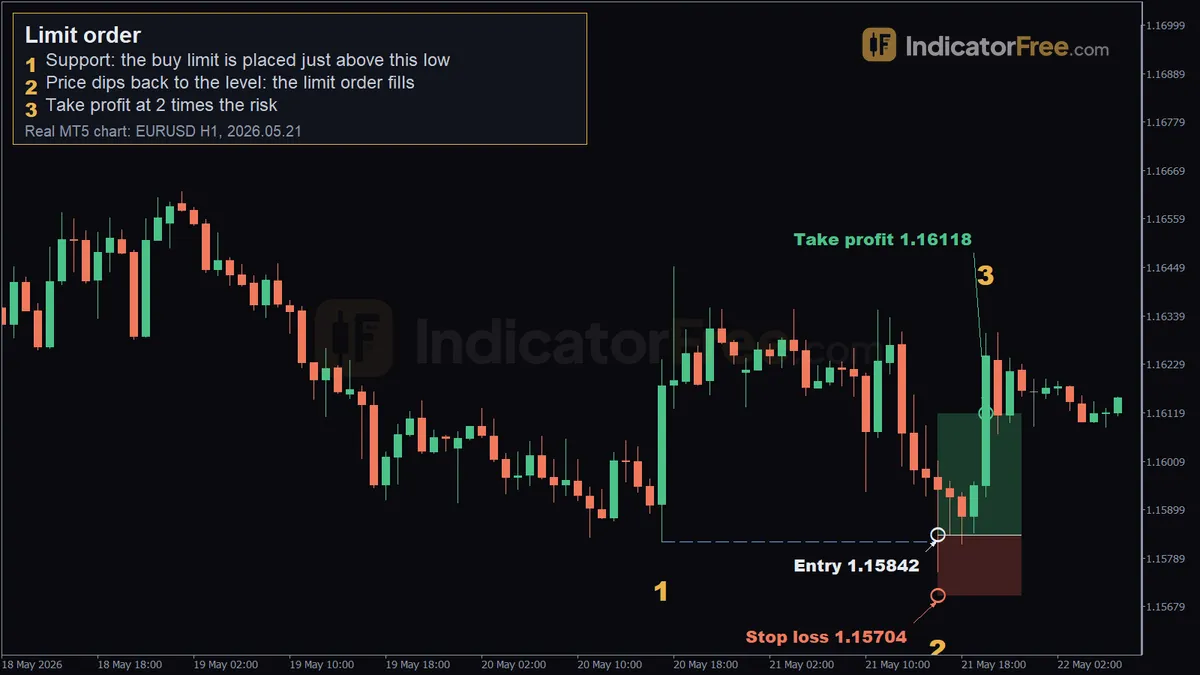
This is a past EURUSD trade on the 1-hour chart. It is an example, not a prediction. Price made a low of 1.15827 on 20 May 2026 at 17:00 server time. A buy limit was placed just above it, at 1.15842.
The order waited almost a full day. It filled on 21 May 2026 at 16:00 server time, when price dipped back to the level. The stop loss was at 1.15704, which is 13.8 pips of risk. The take profit at 1.16118 was 27.6 pips away, twice the risk. Price reached it at 20:00 server time the same day. The chart below redraws the trade.
Note the placement. The limit sat slightly above the old low, not exactly on it, because price often turns a little before a level.
Setting a limit order in the order window
In the order window, choose a pending order instead of immediate execution, then pick buy limit or sell limit. Enter the limit price, the size, a stop loss, a take profit and, if you want, an expiry time.
Checks before you leave a limit order working
- Know which price fills you. A buy limit fills on the ask, the higher of the two quoted prices. Many charts draw the lower one, the bid. So a candle can touch your buy level and still leave you unfilled. That is the spread, not a platform error.
- Attach the stop loss to the order itself. A limit can fill while you are asleep.
- Set an expiry. If the idea is only good for today, the order should not still be working next week.
- Add up every pending order. If you have several limits working, work out your total risk as if all of them fill at once.
- Check the broker's minimum distance. Some brokers reject a limit placed too close to the current price.
- Look at the calendar. A limit sitting in front of a major news release gets filled by the very move you may not want to catch.
FAQ
What is a stop-limit order?
It is two orders in one. When price reaches your stop level, the platform places a limit order at a second price you chose. You get price control on a breakout, but in a fast move the limit may be left behind unfilled.
What happens to a limit order if the market gaps past my price?
It fills at the first available price, which is better than your limit. A buy limit is filled lower than you asked and a sell limit higher. Your stop loss does not get the same protection and can fill worse in a gap.
Can a limit order fill only part of my size?
Yes, mainly on stock and crypto exchanges. If fewer units are offered at your price than you want, you get that part and the rest keeps waiting. Check the order's status before you assume your full position is open.