









Trailing drawdown
Also called Trailing max drawdown, Trailing maximum drawdown, Trailing loss limit, Trailing threshold
A trailing drawdown is a loss limit that moves up as your account reaches new highs. It sits a fixed amount below your highest equity or balance, and it never moves back down when you lose.
The catch is that your own profits raise the level at which you fail. You can be sitting at your starting balance and still be closer to losing the account than on day one. Most traders meet this rule on prop firm challenges and funded accounts.
What a trailing drawdown measures
A fixed loss limit is counted from your starting balance. A trailing drawdown is counted from your high-water mark, which is the highest value your account has reached so far.
The firm sets a distance, such as a dollar amount. Your failure level, often called the floor, is the high-water mark minus that distance.
If your account value touches the floor, the account is closed or the challenge is failed. This happens even if you have never had a large single loss.
How the floor moves: a $50,000 account in numbers
The figures here are an illustrative example. You have a $50,000 account with a $2,500 trailing drawdown.
- At the start, the floor is $50,000 - $2,500 = $47,500.
- You trade well and the account peaks at $51,800. The floor rises to $51,800 - $2,500 = $49,300.
- You give the gains back and return to $50,000. The floor stays at $49,300.
- Your room to lose is now $50,000 - $49,300 = $700, not $2,500.
The chart below shows the floor climbing with each new peak, then holding flat while equity falls into it.
Now size your trades from the buffer you have left, not from the original allowance. Use this rule: divide the buffer by the number of losses in a row you want to survive, plus one. If you divide by the number of losses alone, the last loss lands exactly on the floor and fails the account. In this illustrative example you want to survive 6 losses, so divide by 7.
Spread, slippage and commission also count against the floor, so a real loss can be bigger than the stop alone. That is why the extra share of buffer matters.
The last step uses a 20-pip stop on a USD-quoted pair, where one standard lot is worth $10 a pip, and gives 0.50 lots. On other instruments, such as gold, the value per point is different, so redo the division with that instrument's value.
When the trailing floor stops moving (the lock)
Some programs stop trailing once the floor reaches the starting balance. From then on the floor is fixed and new highs no longer raise it.
In the illustrative $50,000 account with a $2,500 trailing drawdown, the floor reaches $50,000 when the account peaks at $52,500. After that, the floor stays at $50,000, so your buffer is simply current equity minus $50,000.
Read whether your program has a lock and at what level. If it does, your first target is to reach that level so the floor stops following you.
Intraday, end-of-day or static: which rule you have
The same words cover different rules. The difference decides whether an open trade can hurt you.
| Rule type | What moves the floor | Main risk for you |
|---|---|---|
| Static limit | Nothing; it is fixed from the starting balance | Lowest risk: the floor never moves, so profits widen your buffer |
| End-of-day trailing | The closing balance at the end of each trading day | A strong day raises tomorrow's floor |
| Intraday trailing | The highest equity reached, including open trades | Floating profit you never bank still raises the floor |
The intraday version causes a common misread. Say your account is at its high and an open trade floats $1,000 in profit, and you then close it at breakeven. Your balance is unchanged, but the floor rose by $1,000 and stays there. You lost $1,000 of buffer without a single losing trade.
If your rule is intraday, bank part of a winner or tighten the stop once floating profit is large compared with your buffer.
Where you see the trailing floor while trading
The firm's account dashboard is the official source. It usually shows the current floor, sometimes labelled as the maximum loss level or the threshold.
Your trading platform shows balance and equity, but it normally does not know the firm's rule.
So keep your own number. Write down the highest balance or equity the rule counts, subtract the distance, and set an equity alert a little above that floor.
Checks before you trade under a trailing drawdown
- Read which value trails. Check whether it is equity with open trades or closed balance, and whether it updates in real time or at the end of the day. Also check whether the floor locks, as described in the lock section above.
- Recalculate the buffer every session. Use current equity minus current floor, never the headline allowance.
- Do not raise size just because the account is up. After a peak, every dollar you give back is buffer gone for good.
Check whether your strategy fits inside the allowance
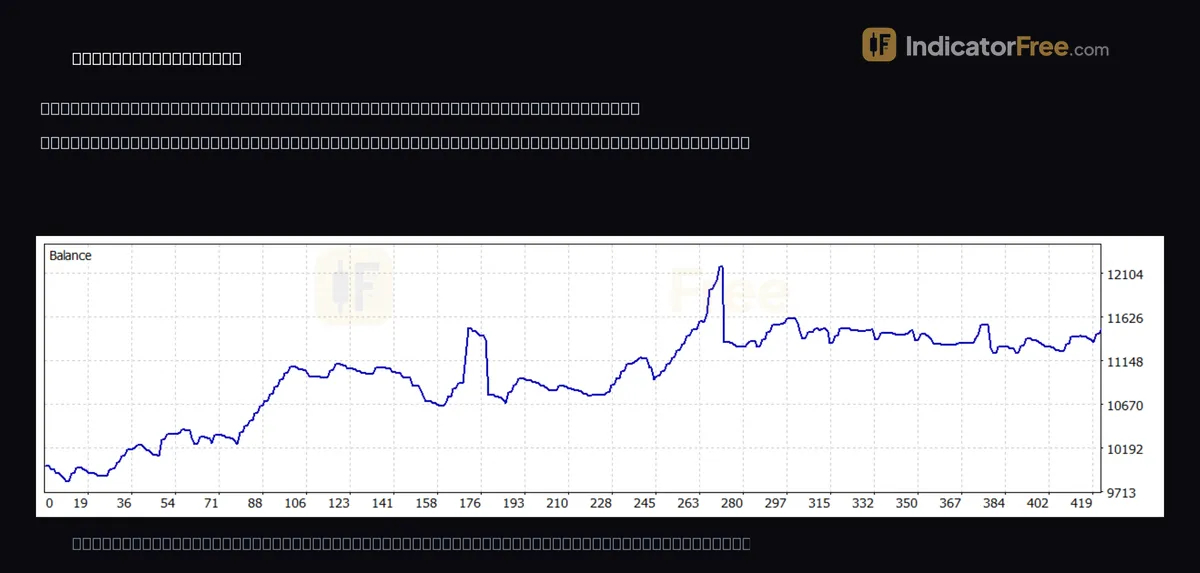
A strategy's maximum drawdown is measured from peak to trough, the same way a trailing floor measures you. The backtest at the top of this page shows a maximum balance drawdown of 7.78%. It is a past result, not a prediction, but it is the figure to size from. Your safety share is the part of the allowance you are willing to use, kept below 100% so a worse drawdown or extra costs do not reach the floor. Use this rule:
Allowance % ÷ past max drawdown % × your safety share = the size multiplier.
Use the same 7.78% for both rule types, closed-balance and intraday. An intraday rule trails every equity high, including floating profit, so the drop it measures cannot be smaller than the closed-balance drop. The report's lower equity drawdown figure is measured a different way, so it understates the risk under that rule.
Illustrative example: a $2,500 allowance on a $50,000 account is $2,500 ÷ $50,000 = 5%. With a safety share of 80%, that is 4%. Then 4 ÷ 7.78 ≈ 0.51, so trade at about half the tested size under either rule type.
Compare percentages, not the report's currency amounts, because those depend on the test account's size.
FAQ
Does a payout or withdrawal change my trailing drawdown?
It can. A withdrawal lowers your balance while the floor usually stays where it is, so your buffer shrinks by the amount you take out. Check the firm's payout rules before you request one.
Do commissions and swaps count toward the trailing drawdown?
Yes. They reduce your balance and equity like any other cost, so they bring you closer to the floor. Overnight swaps on a position held for days can eat a thin buffer.
Does the trailing drawdown reset when I pass the challenge or get a funded account?
Often, yes. A funded account is usually a new account, so the high-water mark and the floor start again from its starting balance, and profit made in the challenge does not carry over as buffer. Programs differ, and some apply a different drawdown rule at the funded stage, so read the funded-account terms before your first trade.