Maximum drawdown rule
Also called Max drawdown rule, Maximum loss rule, Max loss limit, Overall drawdown rule, Trailing drawdown rule
The maximum drawdown rule is a prop firm or account limit on how far your equity or balance may fall, measured from the starting balance or from its highest point. Cross that level and the account is usually closed.
The percentage in the rulebook is not the number you trade against. What matters is the account level where the rule bites, called the floor, and whether that floor stays put or climbs behind your profits.
What the maximum drawdown rule actually measures
The rule takes a reference point and subtracts an allowed loss. The result is your floor. If the account touches it, the rule is broken.
Three details decide how strict it is: the reference point (starting balance or highest point reached), what is measured (balance or equity), and when it is checked (every tick or once at the end of the day). Two firms can print the same percentage and give you very different room.
Balance counts closed trades only. Equity adds the floating profit or loss of open trades. A rule written on equity can be broken by a position you have not closed.
Static or trailing: where your floor sits
A static drawdown fixes the floor under the starting balance for the life of the account. A trailing drawdown moves the floor up each time the account makes a new high, and never moves it back down. Some trailing floors stop rising once they reach the starting balance; from then on the rule behaves like a static one.
| Rule type | Floor moves? | Measured from | What catches traders |
|---|---|---|---|
| Static | No | Starting balance | Little; profit adds room |
| Trailing on closed balance | Up, after closed profit | Highest balance | Banked profit no longer adds room |
| Trailing on equity | Up, on open profit too | Highest equity | A winner that retraces still lifts the floor |
The trailing-on-equity version is the common misread. A trade that runs into profit and then comes back to break-even costs you nothing in balance, yet the floor has already followed the peak.
Checked every tick or at the daily close: when a dip breaks the rule
When the rule is checked changes what can break it. A rule checked on every tick is broken the moment equity touches the floor, even if price recovers a minute later. A rule checked once at the end of the day ignores an intraday dip and reads only the closing figure, so the same dip does no harm.
Worked example: how much room is left and what size to trade
The figures here are an illustrative example. You hold a $100,000 account with a 10% maximum drawdown rule, so the allowed loss is $10,000. The account's equity climbs to $104,000, then falls to $95,500, and the trailing rule is read on equity.
Under a static rule the floor is $100,000 − $10,000 = $90,000. Your room is $95,500 − $90,000 = $5,500.
Under a trailing rule the floor followed the peak: $104,000 − $10,000 = $94,000. Your room is $95,500 − $94,000 = $1,500. The chart below shows both floors against the same equity curve.
Now turn room into trade size. A simple decision rule: decide how many losing trades in a row you want to survive, add one, and divide the room by that number. The extra share keeps the last loss above the floor, and commission and slippage come out of the same room. With $1,500 of room and four losses to survive, a 30-pip stop on a USD-quoted pair (a standard lot is worth $10 a pip) gives this:
If you had sized from the static room instead, you would risk $5,500 ÷ 5 = $1,100 per trade. Two such losses would break the trailing rule.
Balance or equity: one account, two drawdown figures
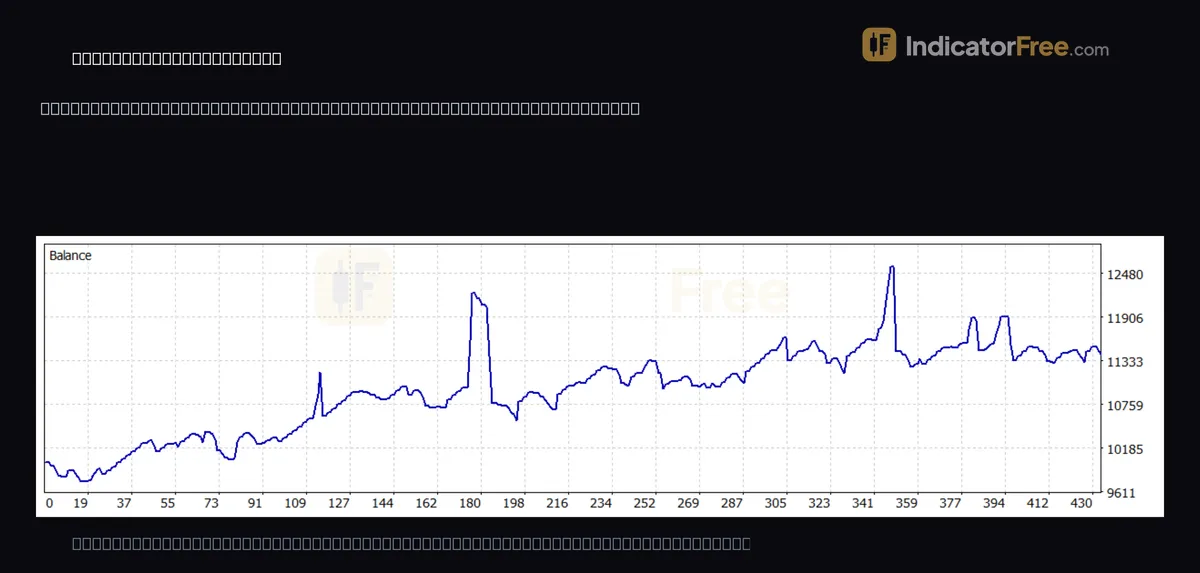
The backtest report at the top of this page shows how far apart the two can sit. An EA on XAUUSD, 15-minute chart, from 2026.07.24 to 2026.09.24, made 293 trades with a maximum equity drawdown of 384.17 (3.30%) and a maximum balance drawdown of 1,675.73 (13.71%). This is a past example, not a prediction. The two figures can differ in either direction, so do not assume which one will be larger.
Against a limit that falls between those two percentages, the same run passes on one measure and fails on the other. A report's maximum drawdown is measured from a peak to the low that follows, which matches a trailing rule, so do not set it against a static limit measured from the starting balance. Before you compare any strategy report with a rule, check that both use the same measure.
Checks before you place a trade under this rule
- Write down today's floor as a money level, not a percentage.
- Set your own cut-off at least one planned loss above the floor: if equity reaches it, close everything and stop trading.
- Confirm the rule's three details in the firm's terms, and whether a trailing floor ever stops rising.
- Add up the stop-loss risk of every open and pending trade. The total must be smaller than your room.
- Leave a buffer for slippage and gaps; a stop can fill worse than its price.
- Check the daily loss limit separately. It is a different rule and can break first.
FAQ
Do swap and commission count toward the maximum drawdown?
Yes. Both are charged to the account, so they lower balance and equity like a trading loss. A position held for many nights can eat into your room without price moving against you.
What happens to my open trades when I hit the maximum drawdown?
On most funded accounts the firm closes all positions and disables trading. The breach is normally judged at the moment the floor is touched, so a later recovery in price does not undo it. Read your account's terms for the exact procedure.
Does the maximum drawdown reset after a payout or a new month?
That depends on the firm's terms. Some keep the floor where it was, some reset it to the starting balance after a withdrawal, and some lock it at the starting balance once you are in profit. Ask before you request a payout, because a withdrawal lowers equity toward the floor.