









Stop Loss Distance
Also called SL distance, stop distance, stop size, risk in pips
Stop loss distance is the gap between your entry price and your stop loss price, usually counted in pips. Together with your lot size, it decides how much money you lose if the stop is hit.
The distance on its own does not tell you your risk. A 20-pip stop can cost you $2 or $200, depending on how many lots you trade. So set the distance from the chart first, then size the trade to fit your risk budget. Don't do it the other way round.
The stop loss distance formula, and how lot size follows from it
You need two numbers: the pip size and the pip value.
The pip size is the smallest standard price step traders count. It is 0.0001 for most pairs and 0.01 for pairs quoted in Japanese yen.
The pip value is how much money one pip of price movement is worth on a given trade size, in your account currency.
Stop loss distance (pips) = |Entry price − Stop loss price| ÷ pip size
Lot size = Money at risk ÷ (Stop loss distance in pips × pip value per 1 lot)
The vertical bars mean you ignore the sign, so the formula works the same for buys and sells.
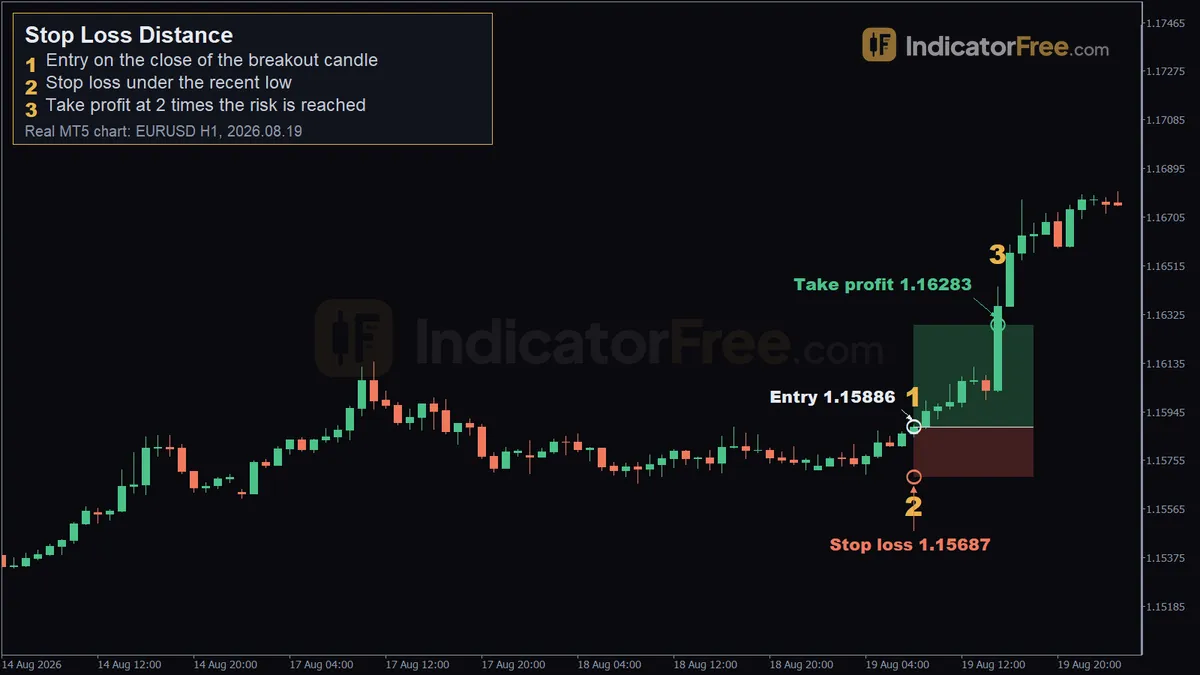
The chart at the top of the page shows a past EURUSD trade on the 1-hour chart. The entry was on the close of the breakout candle and the stop sat just under the recent low.
- Entry and stop. The entry was 1.15886 and the stop loss was 1.15687. The gap is 1.15886 − 1.15687 = 0.00199, and 0.00199 ÷ 0.0001 = 19.9, which rounds to 20 pips.
- Lot size. The pip value for EURUSD is $10 per standard lot, as read from an MT5 demo account. With $100 at risk, an illustrative amount: $100 ÷ (20 pips × $10 per lot) = 0.50 lots.
This is a past example, not a prediction.
Choosing the distance from the chart, not from your budget
Your stop belongs at the price where your trade idea is proven wrong. For a buy, that is usually just below a recent swing low. For a sell, it is just above a recent swing high. The chart below shows why a stop set only to save money gets hit.
The very next candle dipped to 1.1008. That is 14 pips below the entry and 4 pips past the tight stop, and then price closed back up at 1.1018 and climbed to 1.1052. The 44-pip stop survived. It needed a smaller lot size to keep the same money at risk. Use these decision rules:
- Look at the last 10 candles. If your stop distance is smaller than one typical candle's high-to-low range, noise can hit it. In the chart, candles span 13–23 pips, against a 10-pip stop. Move the stop beyond the swing and cut the lot size.
- If even the smallest lot size risks more than your limit at the chart-based distance, skip the trade. Don't shrink the stop.
- On a sell, the stop is triggered by the ask price, which is the higher of the two quotes. Charts usually show the bid price, so place the stop above the swing high plus the spread. Otherwise the ask can touch your stop before the chart ever does.
How many pips should a stop loss be?
No single number of pips works for every trade. The right distance depends on the pair, the timeframe and where the last swing sits. Use this step to check your stop: measure the typical candle range on the timeframe you trade. If your chart-based stop is less than one range, widen it or skip the trade.
In the EURUSD trade at the top of the page, every 1-hour candle in the 12 hours before the entry had a range of less than 11 pips. The 20-pip stop passed this check.
Sizing a 20-pip stop on $500, $5,000 and $50,000 accounts
The figures in this section are an illustrative example. You risk 1% per trade with a 20-pip stop on EURUSD.
Some pairs have the US dollar as the second currency in their name, such as EURUSD and GBPUSD. On these pairs, one pip is worth $10 on a standard lot (100,000 units), $1 on a mini lot (10,000) and $0.10 on a micro lot (1,000) in a USD account.
On other pairs, work out the pip value first: pip size ÷ current price × units. Then convert it to your account currency if needed. For example, with USDJPY at 150.00 and a standard lot: 0.01 ÷ 150 × 100,000 = about $6.67 per pip.
$500 account. Small accounts need one extra step: rounding down to a lot size you can actually trade. The calculation below shows it.
$5,000 account. 1% is $50. Next, 20 pips × $10 = $200 per standard lot. Then $50 ÷ $200 = 0.25 lots.
$50,000 account. 1% is $500. Then $500 ÷ $200 = 2.50 lots.
Quick-reference table: lots per stop distance at 1% risk
This uses the same example assumptions. Lots are rounded down to the nearest 0.01.
| Account | 1% risk | 10-pip stop | 20-pip stop | 40-pip stop |
|---|---|---|---|---|
| $500 | $5 | 0.05 lots | 0.02 lots | 0.01 lots |
| $5,000 | $50 | 0.50 lots | 0.25 lots | 0.12 lots |
| $50,000 | $500 | 5.00 lots | 2.50 lots | 1.25 lots |
Read it across a row. Each time you double the distance, the lot size halves, and the money at risk stays about the same. On small accounts, rounding down to the 0.01 minimum means you often risk less than 1%: $4 instead of $5 here.
Stop loss distance in points versus pips
You usually type the stop as a price in the stop loss field of the order window, so this mix-up can't happen there. It happens when a box asks for the stop as a distance instead. Many platforms count that distance in points, where one point is a tenth of a pip on 5-decimal quotes, so 200 points equals 20 pips. If you enter 20 in a distance box thinking pips, the platform may read it as 20 points, which is only 2 pips.
Stop loss distance mistakes that inflate your risk
- Trading the same lot size every time. A 40-pip stop at the lot size you sized for a 20-pip stop doubles your loss.
- Moving the stop farther away after you enter. Your lot size was set for the old distance, so your real risk grows.
- Ignoring gaps. Over a weekend or around news, price can jump past your stop and fill it worse than planned.
FAQ
Can I use ATR to set my stop loss distance?
Yes, as a cross-check. The Average True Range (ATR) measures how far price typically moves per candle, gaps included, so it puts a number on the noise. Many traders place the stop a multiple of ATR away. Whatever multiple you pick, the stop should still sit beyond the swing that proves your trade idea wrong.
Should I use the same stop loss distance on every currency pair?
No. Pairs move different amounts, so a distance that fits one pair can be inside the noise on another.
Does stop loss distance change with the timeframe I trade?
Yes. Swings on a daily chart are much larger than on a 1-hour chart, so stops below them sit farther away. You keep the same percentage risk by trading fewer lots.