Trading account balance
Also called Account balance, Balance, Forex account balance
Trading account balance is the money in your trading account from deposits, withdrawals and closed trades, after fees and swaps. It leaves out the profit or loss on trades that are still open.
Most traders size their risk from this number. If you read it wrong, you can trade too big. Your balance only moves in steps, when a trade closes or when money goes in or out. Your open trades can be doing much worse than the balance shows.
What changes your balance and what leaves it alone
Your balance follows realized results only. Realized means the trade is closed and the gain or loss is locked in. The table compares it with equity, which is your balance plus or minus the floating profit or loss on open trades.
| Event | Balance | Equity |
|---|---|---|
| You deposit $1,000 | +$1,000 | +$1,000 |
| You open a trade and margin is set aside | No change | No change (only free margin goes down) |
| An open trade is down $150 | No change | −$150 |
| You close that trade at −$150 | −$150 | No change (already counted) |
| Commission charged | Goes down | Goes down |
| Overnight swap | Goes down when posted (daily or at close, depending on your broker) | Goes down as it builds up |
| You withdraw $500 | −$500 | −$500 |
Swap can also be positive. In that case, both columns go up instead of down, with the same timing.
Rows three and four show a common misread. Many traders feel that closing a losing trade is what costs them money, so they keep losers open. Look at equity in that row: the money was already gone before you closed. Closing only made official a loss you already had.
A winning trade works the other way round. Open profit shows up in equity, but it isn't in your balance until you close, so it can shrink before you bank it.
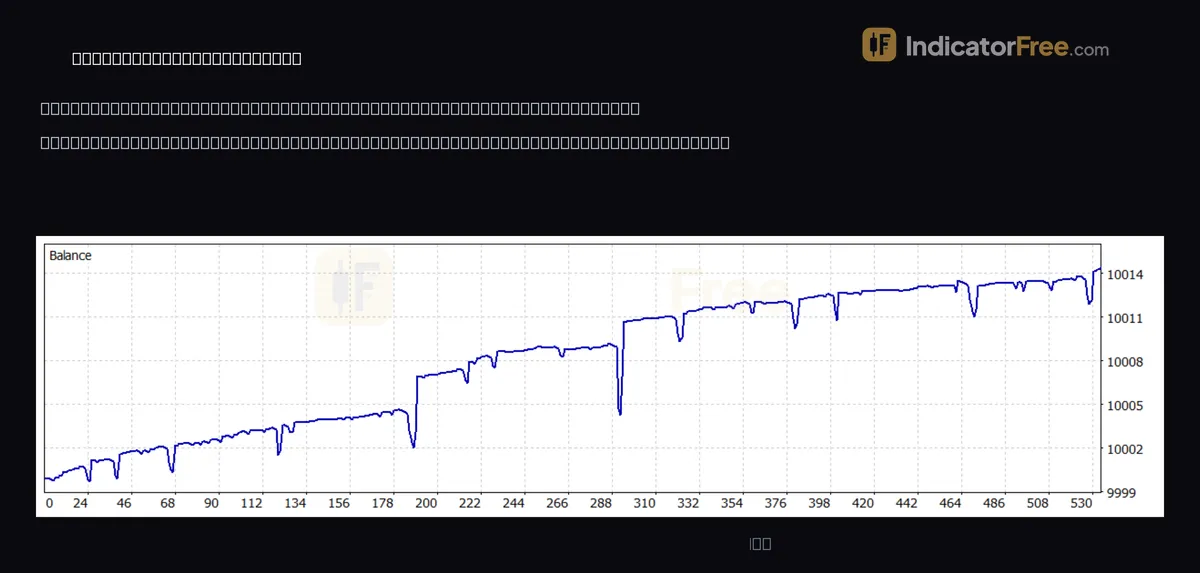
The automated-trading backtest at the top of this page shows the same gap in a real report. It ran on EURUSD on the 15-minute chart from 2026.06.25 to 2026.09.25. That is a past result, not a prediction. The maximum balance drawdown was 5.06 (0.05%) in the account currency. The maximum equity drawdown was 20.22 (0.20%), also in the account currency, and about four times larger. The balance never recorded how deep the open trades went.
Free margin is your equity minus the margin held for open trades. It is the money you can still use to open new positions. Opening a trade locks up margin, but that margin is never taken out of your balance. Because free margin comes from equity, it shrinks as open trades lose, even while the balance stays the same.
Margin calls and stop-out are triggered by equity, not balance. Your broker tracks your margin level, which is equity ÷ used margin, usually shown as a percentage. If it falls to your broker's margin call level, you get a warning. If it keeps falling to the stop-out level, the broker starts closing your trades for you. These levels differ from broker to broker, so look up yours. A healthy balance does not protect you from a stop-out.
Decision rule: before you add a trade, check your margin level, not your balance. If it is falling toward your broker's margin call level, reduce or close positions instead of opening new ones.
Sizing a trade from your balance, step by step
The numbers below are an illustrative example. Your balance is $10,000 and you have no open trades. You risk 1% per trade and set a 25-pip stop on EURUSD. On a USD-quoted pair, one standard lot (100,000 units) is worth $10 per pip.
Because your risk is a percentage of the balance, it shrinks after losses and grows after wins without you doing anything. Use this rule when other trades are still open: size from whichever is lower, balance or equity. If equity is $9,600 while your balance still says $10,000, your 1% risk is $96, not $100.
How to trace each change in your balance
Your account history or statement lists each deposit, withdrawal, closed trade, commission and swap, so you can trace every change in the balance. On a live account, the balance changes only through closed trades, costs, deposits and withdrawals.
Checks before you place the next trade
- Account currency: your balance is in your account currency. If that isn't USD, convert the pip value before you size a trade.
- Balance vs equity: compare the two numbers before every order; if they differ, use the lower one.
- Bonus or credit: some accounts show promotional credit on its own line. Leave it out of your risk sums, because it isn't your money.
- After a deposit or withdrawal: work out your 1% figure again. Yesterday's lot size no longer matches 1%.
- Costs: add up last month's commissions and swaps from your history. If your closed-trade profit before costs is smaller than that total, your balance falls even when you win more trades than you lose.
FAQ
Can I change the balance on a paper trading or demo account?
Usually, yes. On a live account you can't set the balance to a number you choose, but most paper trading and demo accounts let you set the starting amount, or reset it in the account settings. Choose roughly what you would really deposit. Practicing with a much larger balance teaches you lot sizes you can't afford.
Why did my balance change when I had no trades open?
Check your history for a deposit, a withdrawal, an account fee or a correction from the broker. It can also be a fee or adjustment the broker posted later for a trade you already closed (for example a late swap or commission correction).
Can my trading account balance go negative?
Yes. On a leveraged position, the loss can be bigger than your whole balance when price jumps past both your stop and the broker's stop-out level. Some brokers offer negative balance protection, which resets the balance to zero. Check your broker's terms before you trade with leverage.