Wick
Also called Shadow, Tail, Candle wick, Upper wick, Lower wick
A wick is the thin line above or below a candlestick's body. It marks the highest and lowest prices traded in that period that price could not hold until the candle closed.
A long wick shows you a price the market tested and refused. If you read it correctly, you can put your stop loss beyond that refused price. That keeps it out of the zone where a normal swing would take you out.
Measuring a wick: upper wick, lower wick and the body between
Every candle has four prices: open, high, low and close. The body is the box between the open and the close. The upper wick runs from the top of the body to the high. The lower wick runs from the bottom of the body to the low. Some traders call a wick a shadow or a tail.
The drawing below shows both kinds on one bullish and one bearish candle.
To measure a wick, you subtract. The upper wick is the high minus the higher of the open and close. The lower wick is the lower of the open and close minus the low. On a 5-digit pair such as EURUSD, a pip is the fourth decimal place, so move the decimal point four places to the right to get pips.
A long lower wick means sellers pushed price down and buyers pushed it back before the close. A long upper wick means the reverse: buyers pushed price up and sellers pushed it back.
Six checks before you treat a wick as a signal
- Wait for the candle to close. Until it closes, a wick can still turn into body.
- Measure the wick against the body. A common rule of thumb is a wick at least twice as long as the body. Shorter wicks are normal noise.
- Compare with recent candles. The whole candle should be at least as big as the last several candles. A long wick on a tiny candle tells you little.
- Check where it formed. The wick should touch a level you care about, such as a prior swing high or low, support, resistance or a zone.
- Check the opposite end. If you are trading a lower wick, the upper wick should be small, and the other way round.
- Check the clock. A wick printed during a major news release or a thin session tells you less.
Valid, weak and broken wicks
A valid wick rejects a level you had marked before the candle formed. It closes back on the right side of that level and is clearly longer than the body.
A wick is weak when it forms in the middle of a range with no level nearby. It is also weak when the candle has wicks of similar length on both sides, because that shows indecision rather than rejection. A single news spike is weak too, because price can jump through levels with very little trading at each one.
A wick is broken when a later candle closes beyond its tip. If a candle closes below the low of a long lower wick, the buyers who defended that low have lost. The setup is cancelled: exit, or don't enter.
A common mistake is to treat every long wick as a reversal. In a strong downtrend, long lower wicks often show up just before the next leg down because they only mark a pause. To spot the difference, look at the next candles. If they hold above the wick candle's body, the rejection is holding. If they close back near its low, it was only a pause.
The EURUSD 1-hour lower wick, marker by marker
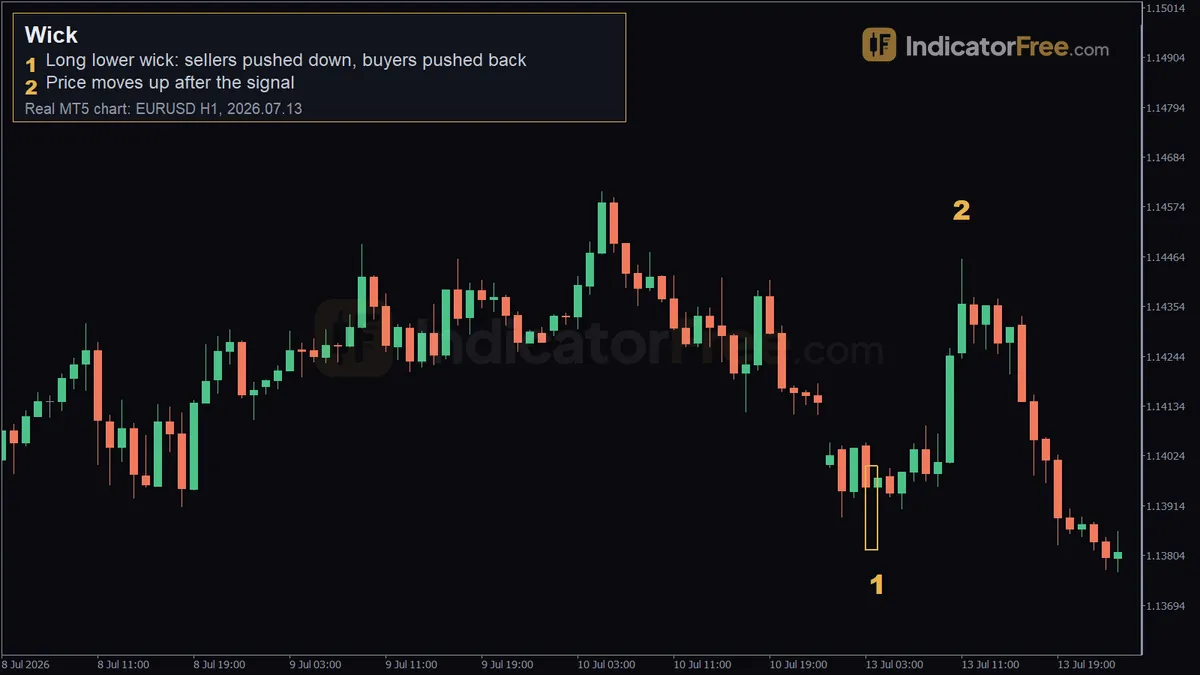
The chart at the top of the page is a past EURUSD 1-hour example, not a prediction.
Marker 1: the long lower wick (2026.07.13 04:00, low 1.13844). The candle opened at 1.13956, dropped to 1.13844 and closed at 1.13975, which was also its high. Do the subtraction:
- Lower wick: 1.13956 − 1.13844 = 0.00112, or 11.2 pips.
- Body: 1.13975 − 1.13956 = 0.00019, or 1.9 pips.
- Upper wick: 1.13975 − 1.13975 = 0.
The lower wick is almost six times the size of the body, and there is no upper wick. Sellers pushed price down, buyers pushed it back, and the candle closed at its top. It clearly passes checks 2 and 5.
Marker 2: the move after the signal (2026.07.13 11:00, 1.14459). Seven hours later, price was at 1.14459. That is 48 pips above the wick candle's close, reached within the next 10 candles. The move was more than four times the length of the wick itself. That will not always happen.
Trading the wick rejection: two setups from the same candle
Both setups use the real prices of the example candle. The entries, stops, targets and account figures below are an illustrative plan built on that candle. They are not trades the chart records.
Setup 1: buy at the close of the wick candle
- Entry: buy at the close, 1.13975.
- Stop loss: a small buffer of 1.9 pips under the wick's tip at 1.13844. Risk: 13.1 pips from the entry down to the tip, plus the 1.9-pip buffer, = 15 pips.
- Target: twice the risk. 15 × 2 = 30 pips above the entry.
In this past example, price went beyond the target and reached 1.14459 by 11:00. Treat that as one case, not a pattern.
To size the trade, take a $3,000 account that risks 1% per trade. One standard lot (100,000 units) of EURUSD moves $10 per pip.
Setup 2: limit buy at the wick's 50% level (wick CE)
In smart money concepts, the midpoint of a wick is called its consequent encroachment (CE). The idea is that price often comes back partway into a long wick. Buying at the midpoint gets you a better price.
- CE level: halfway between the wick's tip at 1.13844 and the body's bottom at 1.13956, which is 5.6 pips above the tip.
- Entry: buy limit at that midpoint.
- Stop loss: the same stop, 1.9 pips under the tip. Risk: 5.6 + 1.9 = 7.5 pips.
- Target: 7.5 × 2 = 15 pips above the entry.
The trade-off: you risk half as many pips, but the order may never fill. The facts for this chart do not show whether price came back to the midpoint, so don't assume it did. If price moves away without touching your limit, let the trade go.
The illustration below shows the general shape: a lower wick dips through support, the candle closes back above it, and the 50% line marks the CE entry.
When wick signals help and when to skip them
Wicks tend to tell you the most at a level you marked in advance, on 1-hour and higher charts, and right after a fast move into that level. They also count for more when the next candle holds the rejection.
Skip them during high-impact news, in tight ranges where every candle has wicks on both sides, and on 1-minute charts, where the spread alone can draw a wick. Also skip a single wick that goes against a strong trend when the market structure has not changed.
| Pros | Cons |
|---|---|
| Visible on any chart, no indicator needed | Only readable after the candle closes |
| The wick tip gives a clear, logical stop | A wide wick means a wide stop and a smaller position |
| Shows where orders were absorbed | Often appears inside trends without reversing them |
| Works for both buy and sell ideas | News spikes and thin feeds create misleading wicks |
Bull wicks and bear wicks
A bull wick is a long lower wick: buyers rejected lower prices, which may mark a floor. A bear wick is a long upper wick: sellers rejected higher prices, which may mark a ceiling.
Some wick shapes have their own entries. A very long wick with a small body at one end is a Pin bar. Long wicks on both sides of a near-zero body make a Doji. A wick that pokes through a prior high or low and snaps back is a Liquidity sweep.
Practical tips for trading wicks
- Mark your levels before the candle forms. If you look for a level only after you see the wick, it is easy to over-read it.
- Put your stop beyond the wick's tip plus a buffer at least as big as the spread. Never put it inside the wick.
- Use a decision rule: if the wick is at your level and passes the six checks, plan the trade. If not, just note the level.
- Check the next higher timeframe. A 1-hour wick into a 4-hour level counts for more than one in open space.
- Brokers' price feeds can print slightly different wick tips. Leave a buffer rather than putting your stop exactly at the low.
- If a long wick forces a wide stop, cut your lot size instead of moving the stop closer.
Quick wick checklist
- Candle closed, wick at least twice the body
- Wick tip at a level you marked earlier, opposite wick small
- No news spike, and the next candle does not close beyond the tip
- Stop beyond the tip plus a buffer, target at least twice the risk
FAQ
What is wick fill in trading?
Wick fill means price later trades back into the range of an earlier long wick. Some traders target a partial fill to the wick's 50% level. Others wait for a full fill back to the wick's tip before trusting the level again. Price does not always come back to fill a wick.
What is wick theory in trading?
Wick theory is the idea that a long wick leaves unfinished business, so price tends to come back to it. Treat it as a possible target or entry idea, not a rule. Check how often it happens on your own pair and timeframe before you rely on it.
What is a data wick in trading?
Traders use this name for a spike that shows up on one price feed because of a bad tick or a moment of almost no liquidity. If a wick looks extreme and other charts of the same pair don't show it, don't build a level or a stop on it.
Should I draw support and resistance from the wick or the body?
The body shows where price was accepted. The wick shows the extreme it reached. Many traders draw the zone from the body edge to the wick tip, enter near the body and put the stop beyond the tip.