Range breakout
Also called Breakout trading, Opening range breakout, ORB, Box breakout, Session range breakout
A range breakout happens when price closes beyond the high or low of a sideways range, so a quiet market starts moving in one direction. Traders buy above the top or sell below the bottom.
Your entry goes at the edge price breaks, and your stop goes back inside the range. Because you know both prices before you click, you know your risk in money before you enter. The risk is that many moves outside a range reverse quickly.
How to mark a range and its breakout level
The breakout level (also called the breakout point) is the edge of the range that price breaks: the range high for a buy, the range low for a sell. To find it:
- Pick a fixed window of time. This can be the quiet hours before a session opens, or a group of candles that move sideways with no clear trend.
- Mark the highest high and the lowest low inside that window. These two prices are your breakout levels.
- Measure the height of the range in pips. A narrow range compared with the pair's usual daily movement is the kind of range worth trading. As a rule of thumb, if the range is more than about half of the pair's average daily range, skip it.
- Wait for a candle to close beyond one edge, on the same timeframe you used to draw the range.
- Measure how far that close sits from the edge. The distance tells you where your stop can go and how much room is left for a target.
- Check the space beyond the range. If a major daily high or low is a few pips away, price has little room to run.
Strong breakouts vs weak or failed ones
A wick above the range is not a breakout. It only shows that buyers tried and sellers pushed price back. Only a candle that closes beyond the edge counts.
A breakout fails when the next one or two candles close back inside the range. When that happens, the reason for the trade is gone, and you exit instead of hoping.
A breakout candle that closes far beyond the edge looks strong, but it makes a poor entry. Your stop has to sit back inside the range, so the risk is large before the trade even starts. If the candle closes more than one range-height beyond the edge, wait for a pullback instead of chasing it.
A strong breakout closes clearly beyond the edge and does not close back inside afterwards. If price pulls back, the old edge often acts as a floor on the way back down. The chart below shows a wick-only poke, a real close above the range, and a pullback that holds above the old high.
Reading the EURUSD example: a quiet night range, then a midday close above it
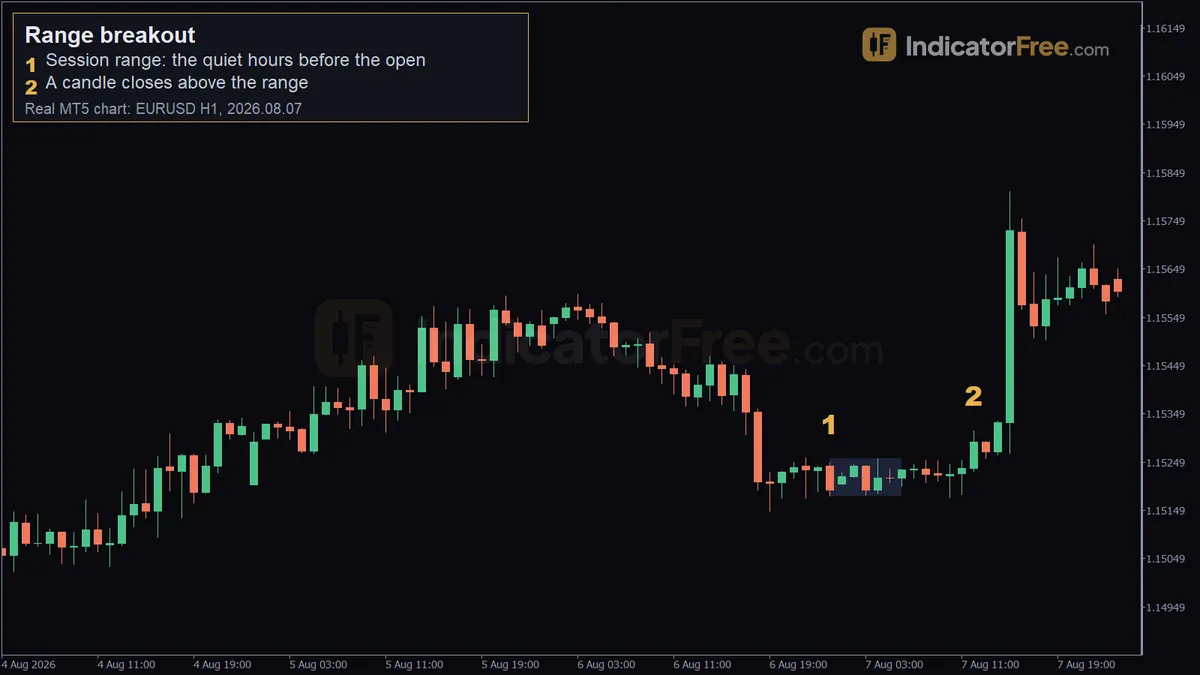
The chart at the top of the page is a past example on the EURUSD 1-hour chart. It is not a prediction.
Marker 1, the session range. From 00:00 to 06:00 on 2026.08.07, price stayed between 1.15178 and 1.15256. That is a box of about 8 pips (7.8 to be exact) during the quiet hours before the main session opened. The marker sits at 1.15246, near the top of the box.
Marker 2, the breakout close. The 12:00 candle on the same day closed at 1.15290, which is 3.4 pips above the range high of 1.15256. The marker sits at 1.15313, above that candle. The 12:00 candle, six hours after the range window ended, closed above it; the 00:00-06:00 box was still the reference.
Trading the EURUSD range breakout: two setups
Both setups use the real prices from the example above. The chart does not tell you how either trade would have ended.
Setup 1: buy the close above the range
- Entry: 1.15290, the close of the 12:00 breakout candle.
- Stop loss: a little below the range low of 1.15178. The range low is 11.2 pips below the entry, so with a small buffer that is 12 pips of risk. A tighter option is a stop just below the middle of the range, for about 8 pips of risk.
- Target: twice the risk. With the 12-pip stop, that is 24 pips above the entry. With the 8-pip stop, it is 16 pips above the entry.
Setup 2: buy a pullback to the range top
- Entry: a limit order just above the old range high of 1.15256.
- Stop loss: below the middle of the range, for about 5 pips of risk.
- Target: twice the risk, 10 pips above the entry. The trade-off is that price may never come back, and then the order never fills.
Why the classic target fails here. The textbook target adds the range height to the breakout edge: 1.15256 + 7.8 pips. That lands only 4.4 pips above the Setup 1 entry, while the stop is 8 to 12 pips away. Use this rule: if the measured-move target is closer to your entry than your stop is, switch to an R-multiple target (a target set as a multiple of your risk), use the retest entry, or skip the trade.
To size Setup 1, here is an illustrative example: a $6,000 account risking 1% per trade, with the 12-pip stop. On EURUSD, one standard lot of 100,000 units is worth $10 per pip.
Opening range breakouts and session ranges
An opening range breakout uses the high and low of the first part of a session as the range. For example, you might take the first hour after London or New York opens, or the first 15 or 30 minutes after a stock market opens. You then trade the first close beyond either edge, using the same rules as above.
The EURUSD example uses a related approach. It boxes the quiet hours before the active session. With either approach, use the same window every day so your levels are consistent and you can compare one day with the next.
When range breakouts work and when to stand aside
Range breakouts tend to work best when a narrow range forms before a busy session. More traders arrive at the open, and their orders can carry price out of the box. They work poorly when the range is already wider than about half of the pair's average daily range, or when price has already crossed the same edge several times without following through.
Stand aside in these cases:
- in the minutes before high-impact news, when spikes break both edges;
- during thin holiday markets;
- late on Friday, when a breakout has no time left to develop.
| Pros | Cons | |
|---|---|---|
| Levels | Entry and stop come from clear, objective prices | Range edges are visible to everyone, so stops cluster there |
| Risk | Risk is known in pips before you enter | A late close forces a wide stop |
| Timing | A fixed time window makes it easy to repeat every day | Breakouts can come hours later, or not at all |
| Market type | Catches the start of a new move | Fails often in flat, low-volume conditions |
Write the range height and the breakout time in a trade log. After a few weeks you will see which ranges suit your pair.
Quick checklist before you take a range breakout
- Range marked from a fixed window, with height measured in pips
- A candle has closed beyond the edge
- Stop placed back inside the range, and the target is at least as far as the stop
- No high-impact news due in the next hour
- Lot size calculated from your stop distance
FAQ
Where do I move my stop once the breakout is running?
Leave it where you placed it until price has moved at least as far as your risk. After that, you can move it to break-even, or just below the old range high once a pullback has held there. Moving it up too early gets you stopped out on a normal retest of the edge.
Should I enter with a pending order or wait for the candle to close?
A pending stop order gets you in early, but place it a buffer beyond the edge, not exactly on it. Size that buffer from two things you can see: it should be wider than the current spread, so normal noise at the edge does not trigger it, and small compared with the range height, so you do not give away most of the move. The EURUSD example has no entry buffer. As an illustrative example only, a 1-pip buffer above the 7.8-pip range would put the buy stop 1 pip above the range high of 1.15256. Waiting for the close avoids the buffer question, at the cost of a later and usually worse entry price. Pick one method and use it consistently so you can judge the results.
How long should a range last before its breakout counts?
There is no fixed minimum. A range needs enough candles that both edges were actually tested, not just touched once. A session window of several hours, like the six hours in the EURUSD example, usually gives you that.