Session high
Also called Asian session high, London session high, New York session high, Session top
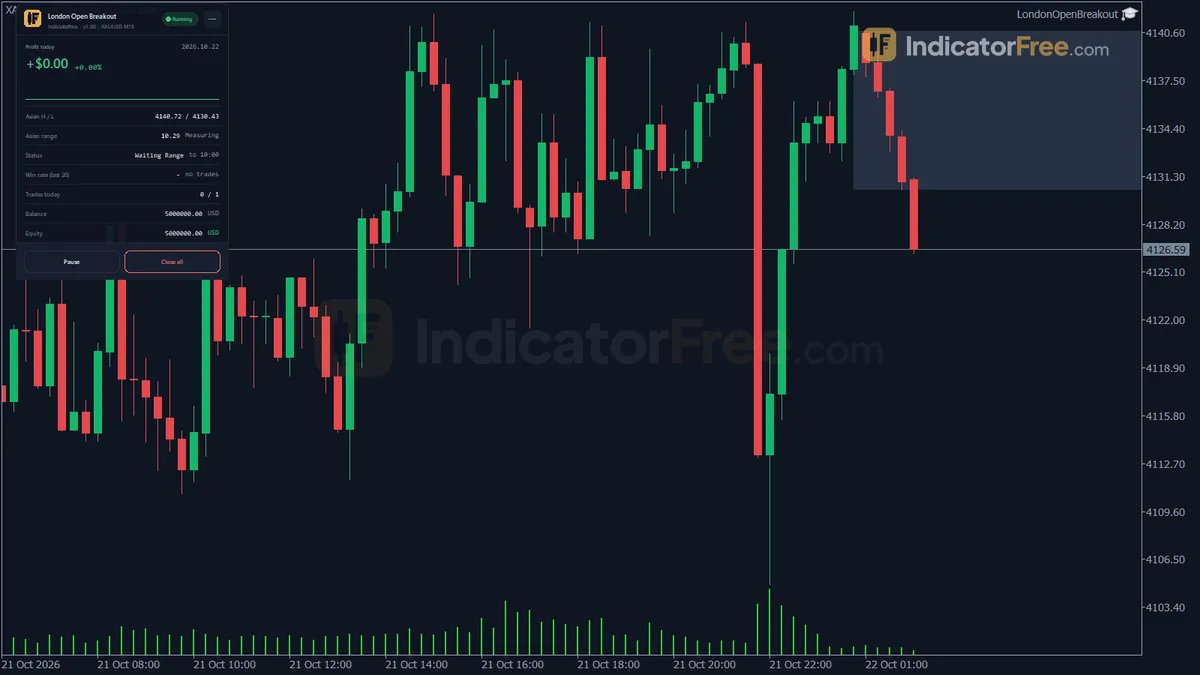
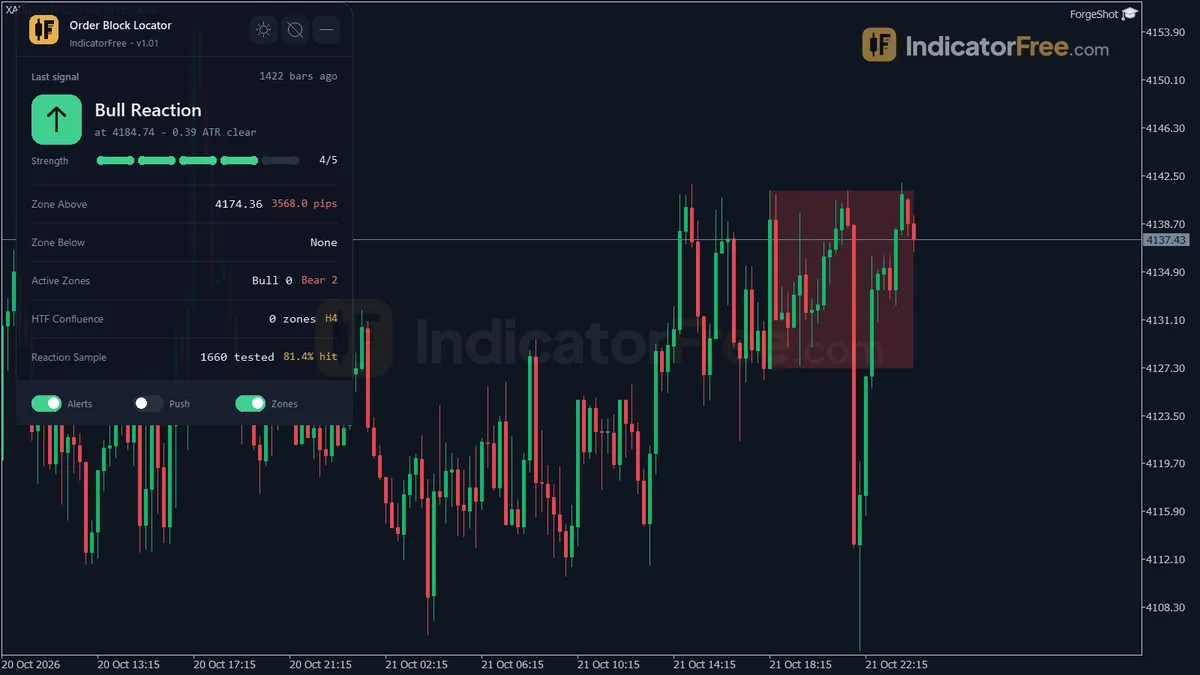
A session high is the highest price reached during one trading session, such as the Asian, London or New York hours. Traders mark it as a level to watch for breakouts, stop runs and reversals.
The session high matters to your money because short sellers tend to park their stop losses just above it, and breakout buyers tend to place orders there. If you buy just under it, or put your own stop exactly on it, your order sits right where the crowd's orders get filled first.
How to mark a session high: 6-step checklist
- Fix the session window first. Write down the start and end hours in your platform's server time and keep them the same every day. For example, the IndicatorFree Lab counts Asian hours as 01:00-09:59 server time. If you change the window after the fact, the high just moves to wherever suits you.
- Use a 1-hour chart or lower. On a 4-hour or daily chart, one candle can cover more than one session, so you can't tell which session printed the high.
- Take the highest wick, not the highest close. The session high is the top of the tallest wick inside the window. Stops are placed above wicks, not above closes.
- Freeze the level when the session ends. Draw a horizontal line and stop updating it. A level that keeps moving can't serve as a reference.
- Mark the session low as well. The distance between the high and the low is the session range. You need it to set targets and to judge how quiet the session was.
- Compare the range with normal candle size. If the whole range is only two or three average candles for that session, it was a quiet build-up. If it is many times larger, the high probably came from one burst.
Strong, weak and broken session highs
A strong session high has been tested more than once inside a compact range, and each test left a rejected wick. Every test adds more stops above the line.
A weak session high was printed by a single spike, often a news release, or in the last minutes of the window. Nobody defended it, so price may ignore it later.
A session high is broken only when a candle body closes above it and the next candles stay above. A wick that pokes above and then closes back inside is a sweep: the stops were hit, but buyers did not take control.
The most common misread is calling a wick through the line a breakout and buying the next candle. Decision rule: if the candle that crossed the level closes back inside the range, treat it as a sweep, not a break.
The EURUSD example: a session high that capped the quiet hours
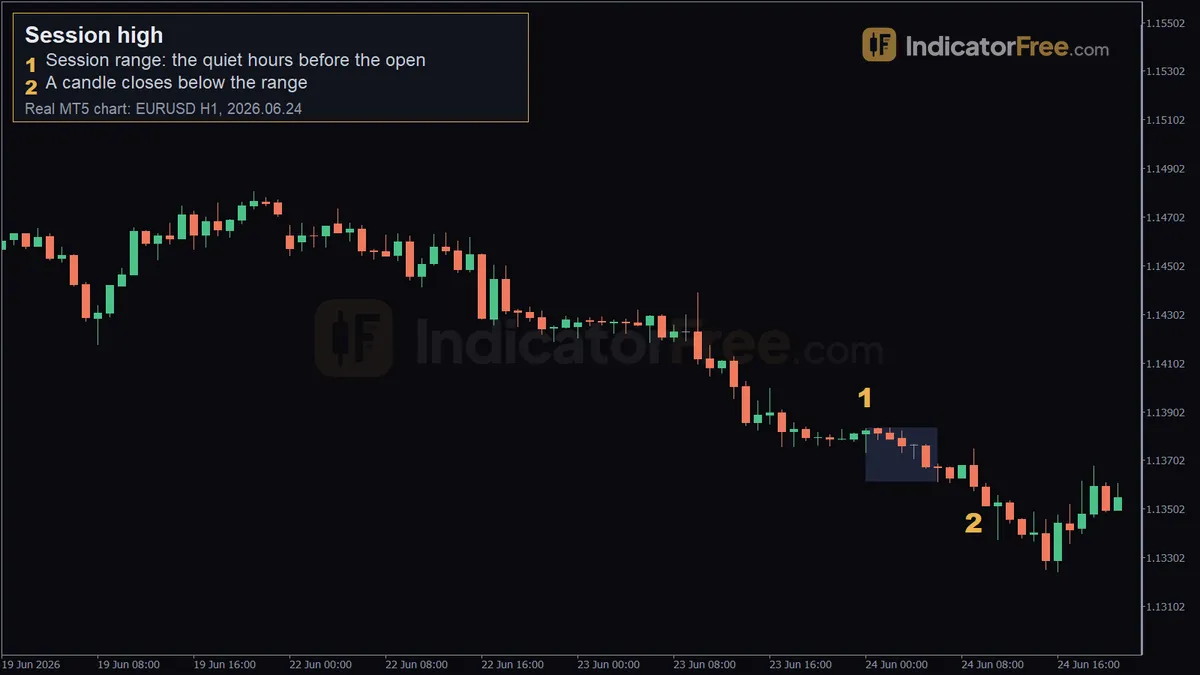
The chart at the top of the page is a past EURUSD 1-hour example, not a prediction.
Marker 1 shows the session range. From 2026.06.24 00:00 to 06:00, price stayed between 1.13614 and 1.13836, a range of only 22 pips. The marker sits at 1.13833, at the top of the box, so the session high is 1.13836.
For scale, the IndicatorFree Lab measured an average 1-hour EURUSD candle of 8.8 pips during Asian hours (EURUSD 1-hour, 2025-10-02 to 2026-10-02, past data, not a forecast). So the whole six-hour range was only about two and a half average candles: a tight session.
Marker 2 sits near 1.13576, on the 09:00 candle. That candle closed at 1.13596, below the range low of 1.13614. The break came on the downside, and the session high was never taken out.
The high still had a job, though. For a short trade on this break, it is the level that proves you wrong. If price climbs back above 1.13836, the quiet range has broken upward instead.
Here is how the rules apply to these past prices (a teaching plan, not a recorded trade):
- Sell at the close: 1.13596.
- Stop 1 pip above the session high of 1.13836: 25 pips of risk.
- Range-height target: a further 22 pips below the range low of 1.13614, which is 20.2 pips from the entry.
The risk is bigger than the reward. Decision rule: when a stop beyond the opposite session extreme is larger than the measured target, move the stop to the range midpoint or skip the trade. Here the midpoint sits halfway between 1.13614 and 1.13836, which cuts the risk to 12.9 pips. Notice too that the close was only 1.8 pips beyond the low, so this was a thin break.
Session-high setups with entry, stop and target
The two setups below are an illustrative example. They are told in pips measured from the session high, not in real prices, and are not taken from a real chart.
Setup 1: close above the session high, then buy the retest
The session range is 20 pips tall, from the session low up to the session high. A candle closes 12 pips above the high. You don't chase that candle. You wait for the pullback.
The retest candle dips to 1 pip above the old high, holds there and closes 6 pips above it. Entry: buy on that close. Stop loss: the range midpoint, 10 pips below the session high, which is 16 pips from your entry. Target: 32 pips above the entry, which is twice the risk. The chart below shows the old ceiling turning into a floor.
To size this trade on an $8,000 account risking 1%, use the 16-pip stop and the textbook $10 pip value of one standard lot on a USD-quoted pair:
Setup 2: sweep of the session high, then sell the close back inside
Now the session range is 40 pips tall. In the next session, a candle wicks 8 pips above the session high and then closes back inside the range, 6 pips below the high. Stops above the high were hit, but price could not hold there.
Entry: sell on that close. Stop loss: 3 pips above the sweep wick, which is 17 pips of risk. Target: the session low, 34 pips away, twice the risk. The drawing below shows the wick above the line and the close back inside.
When session highs work and when to skip them
Session highs are most useful when a quiet session hands over to a busier one. A high built in calm hours then meets bigger candles that can push through it or sweep it. The chart below shows how candle size grew through the day on EURUSD (EURUSD 1-hour, 2025-10-02 to 2026-10-02, Lab counts, past data, not a forecast).
Don't assume every market behaves this way. On gold over the same period, the Lab measured an average 1-hour candle of 21.3 $ in Asian hours and 18.9 $ in the London morning (XAUUSD 1-hour, 2025-10-02 to 2026-10-02, past data, not a forecast). On that data, Asian hours were not the quiet part of gold's day, so its Asian high is a less reliable ceiling.
Skip the level when high-impact news is due near the session handover, when the range is already far wider than normal, or when price is sitting in the middle of the range. Late New York hours are another time to step back: EURUSD candles shrank to 10.4 pips there in the same Lab data.
| Pros | Cons | |
|---|---|---|
| Clarity | One objective price that anyone can mark the same way | Depends on which session hours you choose |
| Risk | Gives a natural place for your stop | Stops placed right at it get swept |
| Targets | The range height gives a ready measured target | Wide ranges give poor risk-to-reward |
| Timing | Tells you when to pay attention (the handover) | Useless in slow, holiday-thin hours |
Bullish and bearish session highs
Bullish: a body closes above the session high and the next candles hold above it. The old ceiling becomes a floor, which is the basis of Breakout retest and Range breakout trades.
Bearish: price sweeps above the session high and closes back inside, which traps late buyers. This is the False breakout pattern. Nearby levels that behave in a similar way have their own entries: Previous day high, Swing high and Equal highs.
Practical tips for trading the session high
- Write your session hours down once, in server time, and use the same hours every day.
- Put your stop beyond the wick plus a small buffer, never exactly on the line.
- Never buy the first poke above the high. Wait for a body close, then for the retest.
- Before the session handover, check whether high-impact news is due inside the next hour.
- Before you enter, compare the stop distance with the measured target. If the stop is larger, use the midpoint stop or pass.
- Delete session highs older than the previous day so the chart stays readable.
Quick checklist before you trade it
- Is the high taken from the highest wick inside a fixed window?
- Was the range quiet compared with normal candle size?
- Did the candle close with its body beyond the level, or only wick through it?
- Is the target at least as large as the stop?
FAQ
How many trading sessions are there in a forex day?
Most traders split the 24-hour forex day into three main sessions: Asian, London and New York. London and New York overlap for a few hours. Each session has its own high and low.
Does a session high work on stock charts?
Yes. Stocks trade in a regular session plus pre-market and after-hours trading. Stock traders often mark the pre-market high and the regular-session high separately, because the same stop and breakout orders gather above both.
Do I need an indicator to mark session highs?
No. A horizontal line at the highest wick inside your window is enough. An indicator only saves time and keeps the window identical each day, so check that it uses the same hours you trade.
Is yesterday's session high still worth watching today?
A session high that was never touched can still have stops above it the next day. Keep it on your chart until price trades through it. Once it is cleared, remove it.