Forward test
Also called Forward testing, Out-of-sample test, Forward performance test, Walk-forward test
A forward test runs a trading strategy, with its rules already fixed, on new prices it has never seen: a held-back slice of history, a demo account or a small live account. It checks whether backtest results survive outside the data they were built on.
A backtest can be tuned until it looks good. New prices cannot be tuned. The forward test is the step that stands between a good-looking report and your real money.
What a forward test checks that a backtest cannot
A backtest replays a strategy over past prices. While building it, you usually adjust settings until the results look best, which is called optimisation. The risk is that the settings end up fitting the quirks of that one stretch of history instead of a repeatable edge.
A forward test exposes that risk by using prices that played no part in the tuning. You freeze the rules, then let them run on data you have not looked at. If the edge is real, the results stay in the same range. If it was fitted to the past, they usually fade or turn negative.
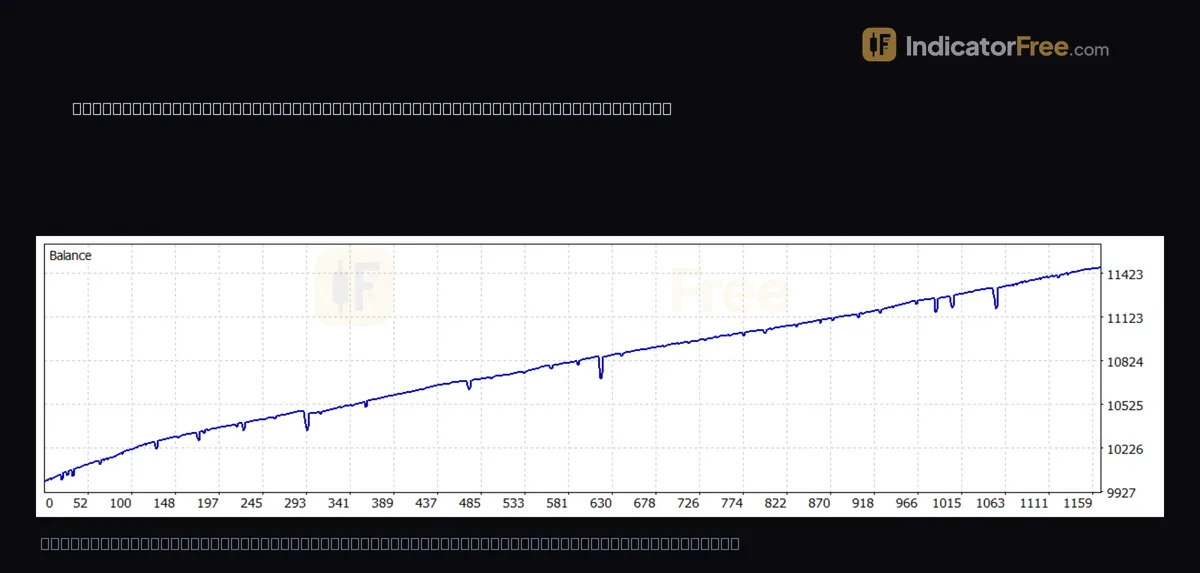
The backtest report at the top of this page is a past example: an Expert Advisor (an automated strategy) on XAUUSD, 15-minute chart, 2026.03.25 to 2026.09.25, with 582 trades, a profit factor of 2.06 and a maximum equity drawdown of 5.70%. Profit factor is gross profit ÷ gross loss. Drawdown is the deepest drop in account equity from a previous peak. Those figures describe past data, not a prediction. A forward test asks whether they hold on prices after 2026.09.25.
The drawing below shows the split. Everything left of the dashed line was available while the rules were built. Everything right of it is new.
The mistake that turns a forward test back into a backtest
One common misread: if you check the held-back slice, change a setting and run it again, that slice is no longer unseen. It has become part of the backtest, and you need fresh data.
This usually happens without you noticing. Assume the forward data is contaminated if any of these is true:
- You opened the forward results more than once before the settings were frozen.
- You changed any setting after seeing even one forward trade, including a small tweak to a stop or a filter.
- You chose the forward period after seeing how the market moved during it.
If any of them applies, count that period as backtest data and start again on prices after it. Demo and live runs follow the same rule: if the rules or settings change mid-test, the count restarts from zero.
Scoring a forward test against its backtest in numbers
The figures in this section are an illustrative example. Your backtest shows a profit factor of 2.00, an average result of $8 per trade and a maximum drawdown of $400.
Before starting, you write down three pass rules: the forward test must keep at least half of the backtest profit factor, at least half of its average result per trade, and its drawdown must stay under 1.5 times the backtest drawdown. Half and 1.5 times are example thresholds you set yourself, not an industry standard.
With the same half and 1.5× rules, a forward test of the Expert Advisor from the report at the top of this page would need a profit factor of at least 1.03 (2.06 ÷ 2). Its average result per trade would need to be at least 1.26 (half of the backtest's expected payoff of 2.52). Its maximum equity drawdown would need to stay under 8.55% (5.70% × 1.5).
You then run 60 trades on a demo account. Winning trades add up to $900, losing trades to $600, and the deepest drawdown is $500.
The strategy kept 0.75 of its profit factor, above the 0.50 rule. The average trade made $5 against $8 in the backtest, which is 0.625 and also above half. Drawdown came in at 1.25 times the backtest, under the 1.5 limit. It passes, and the next step is a small live size, not full size. Sixty trades is enough to catch a broken strategy, not to prove a good one, which is why that next step stays small.
Some fade is normal, because a backtest is always the best-fitted view. What matters is how much fades. A forward profit factor below 1.00 means the frozen rules lost money on new prices.
Where you run a forward test on your trading platform
There are three places, and they answer different questions.
| Method | Prices used | Fills and costs | What it tells you |
|---|---|---|---|
| Held-back history | Past data kept out of the tuning | Simulated | Fast first filter for over-fitting |
| Demo account | Live market, as it happens | Real quotes, simulated fills | Whether the rules cope with live spreads and news as it happens; it still misses real slippage and partial or rejected fills |
| Small live account | Live market, as it happens | Real spread, slippage and swaps | Whether the edge survives real execution |
For held-back history, most backtesting tools let you split the date range into a tuning part and a forward part. For demo and live runs, you attach the strategy to a chart, or trade the rules by hand, and read the results from the account's trade history report.
How walk-forward testing repeats the idea
Walk-forward testing is a chain of forward tests on history. You tune on one window, test on the next unseen window, then slide both windows forward and repeat.
As an illustrative split, tune on 3 months, test on the next 1 month, then slide both windows forward by 1 month. Across 12 months of history that gives 9 unseen test months.
Only the unseen windows are joined into the final result. It shows whether the tuning method itself holds up across several market phases, not just one lucky split.
Set the decision rule before you start. For example: if fewer than 6 of the 9 unseen months are profitable, treat the tuning method as unreliable, even if the joined total is positive.
Checks before you trust a forward test
- Use the same symbol, timeframe and account type you plan to trade.
- Log the spread and slippage on each trade. Costs are a common reason live results trail a backtest, because the backtest often assumed a fixed spread and no slippage.
- Be as suspicious of a forward test that beats the backtest as of one that fails. On few trades, either can be luck.
FAQ
How long should I forward test a day trading strategy?
Count trades, not days. Then run this check: remove the best week from the results and work out the profit factor again. If it drops below your pass rule, keep testing. Also make sure the strategy has traded through both quiet sessions and major news. A day trading strategy gets there sooner than a swing strategy because it trades more often.
What should I do if my forward test fails?
Stop the test and go back to the backtest. Look for the cause, usually too many tuned settings or costs the backtest ignored. Simplify the rules, then test again on data the strategy has not seen.
Can I forward test a strategy I trade by hand?
Yes. Write the entry, stop and exit rules down, take every signal, and journal each trade. Record the signals you skipped too, because skipping the hard ones makes the result look better than the rules are.