









Bearish order block
Also called Bearish OB, Supply order block, Sell-side order block
A bearish order block is the last bullish candle before a strong drop that breaks a recent low. Traders mark that candle's range as a zone where sellers may step in again when price comes back to it.
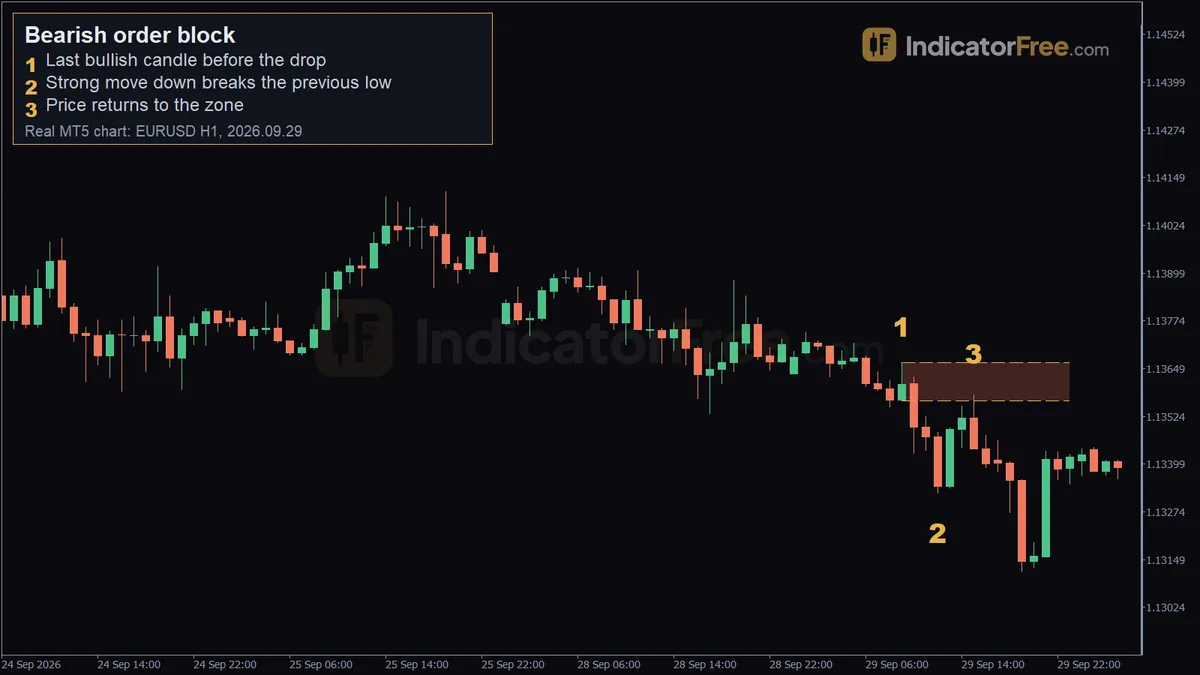
The idea is that large sellers left unfilled sell orders around that candle. When price comes back, they get a second chance to sell. A bullish order block is the mirror image: the last bearish candle before a strong rally that breaks a swing high, used as support.
Knowing where a bearish order block sits tells you two things. It shows where a sell can have a tight stop with a clear reason behind it. It also shows where buying a pullback is risky.
How to spot a bearish order block: the 5-point checklist
- Find a strong drop. The drop should be at least about 3 times the zone height. In the EURUSD example on this page, price fell 32 pips against a 9.9-pip zone, about 3.2 times.
- Confirm the drop broke structure. It must take out the most recent swing low, the lowest point of the last pullback. If no low breaks, there is no order block.
- Mark the last bullish candle before the drop. That candle is the block. If several small up candles sit together, use the whole cluster.
- Draw the zone. Run it from that candle's low to its high. Some traders use the open to the high for a thinner zone.
- Check that it is fresh. Price must not have traded back into the zone since the drop.
The chart below shows all five checks in order: the up candle, the drop through the prior low, and the first return into the zone.
What makes a bearish order block weak or broken
A block is weak when the drop after it is slow and the candles overlap. It is also weak when the zone is tall compared with the drop, because your stop gets too large for the reward. A zone that price has already touched once is weaker too. The sell orders that sat there may already be filled.
A block is broken when a candle closes above the zone high. That close means buyers absorbed the selling, so stop treating the zone as resistance. A wick that pokes above and closes back inside does not break it.
The most common misread: traders mark the red candles of the drop as the block. The block is the up candle before the drop. If your zone sits below the swing low that broke, you have drawn the wrong candles.
Reading the EURUSD 1-hour example, marker by marker
The chart at the top of this page is a past EURUSD 1-hour example, not a prediction.
Marker 1 is the last bullish candle before the drop. It closed at 2026.09.29 09:00, and its range gives the zone: 1.13565 to 1.13664.
Marker 2 is the drop. Over the next 3 candles price fell 32 pips and broke the lowest low of the previous 10 bars, reaching 1.13324 at 12:00. That break passes checks 1 and 2.
Marker 3 is the first return. At 15:00 price came back to 1.13581, inside the zone, then fell 46 pips.
Notice how shallow the return was. From the 1.13565 zone low up to 1.13581 is only 1.6 pips, in a zone that is 9.9 pips tall. An order placed deep in the zone would have missed the move.
Two ways to sell a bearish order block
Both setups below use the prices of the past chart as an illustrative example. The stop sits 5 pips above the zone high of 1.13664, a buffer you can change to suit the pair.
Setup 1: sell limit at the zone's lower edge
A sell limit is a pending order that sells only if price rises to your price.
- Entry: 1.13565, the zone low.
- Stop loss: 5 pips above 1.13664. Risk: 9.9 pips of zone + 5 pips of buffer = 14.9 pips.
- Target: the low of the drop, 1.13324. Reward: from 1.13565 down to 1.13324 is 24.1 pips, about 1.6 times the risk.
The return touched 1.13581, so this order filled. The 46-pip fall that followed went past the target.
Setup 2: sell limit at the zone midpoint
- Entry: halfway through the zone, about 5 pips above 1.13565.
- Stop loss: the same, 5 pips above 1.13664. Risk: about 5 pips of zone + 5 pips of buffer, about 10 pips.
- Target: 1.13324. Reward: 24.1 pips + about 5 pips, about 29 pips, close to 2.9 times the risk.
This order never filled. Price turned at 1.13581, below the midpoint. A better ratio on paper does nothing if the trade never opens.
Decision rule: if the drop away from the zone was fast and large, use the edge, because price may not come back deep. If the zone is too tall for the stop you can afford, use the midpoint and accept missing some trades.
Sizing the trade from the stop
Your stop size, not your feeling about the zone, sets the lot size. In this illustrative example the account holds $10,000, you risk 1%, and the stop is Setup 1's 14.9 pips, rounded to 15 pips. One standard lot (100,000 units) on EURUSD moves about $10 per pip.
When a bearish order block works and when to skip it
The zone has the best odds of holding when the bigger trend is already down. Look for a lower high on the 4-hour or daily chart, a first touch, and a slow climb back into the zone with small candles.
Skip it when the daily chart is in a strong uptrend, when high-impact news is due during the return, or when price keeps chopping sideways. In a range, almost every swing "breaks" a low, so blocks lose their meaning.
| Pros | Cons |
|---|---|
| Gives an exact area for entry and stop | Zones are drawn by eye, so two traders mark different ranges |
| Stop has a clear reason: above the zone high | Shallow returns often miss limit orders |
| Rules can be checked by eye, with no indicator needed | In ranges, false blocks appear everywhere |
| Pairs with structure breaks you already watch | Against a strong higher-timeframe trend, zones fail often |
Practical tips for trading bearish order blocks
- Mark zones on the 4-hour or daily chart, then time the entry on the 1-hour or lower.
- Measure the zone height before you place anything. If the stop above it costs more than your risk limit allows at the smallest lot you can trade, skip the trade.
- Cancel the pending order as soon as a candle closes above the zone high.
- Never move the stop down into the zone after entry. Inside the zone is exactly where price is expected to wobble.
- Set a price alert at the zone edge instead of watching every candle.
Quick checklist before you sell
- Did a sharp drop break the last swing low?
- Is the zone the last up candle, and is it untouched?
- Does the stop above the zone high fit your risk?
- Is the higher timeframe down or neutral, with no big news due?
FAQ
What does bearish mean in trading?
Bearish means you expect prices to fall. A bearish trade profits from a decline, usually by selling first and buying back lower.
Can a bearish order block form on any timeframe?
You can apply the same five checks on any chart, from 1-minute to weekly. Lower timeframes throw up far more zones, and many of them are noise. Traders usually give more weight to blocks on higher timeframes, because those come from bigger moves.
How long does a bearish order block stay valid?
It stays valid until a candle closes above the zone high. A close inside the zone, or a wick above it that closes back inside, does not break it. After the first touch the block is weaker, because some of the sell orders may already be filled, but it is not dead. For old zones, skip the block once price has formed a new swing high above it, because the downtrend that created the block has ended.