









Breakout confirmation
Also called Confirmed breakout, Breakout close confirmation, Close confirmation
Breakout confirmation is the evidence you wait for before you trust a breakout. It usually means a candle closing beyond a support, resistance or range edge, and price staying outside the level afterwards.
The costly mistake is buying or selling the first poke through a level, before the market has shown it will stay outside. A confirmation rule costs you a few pips of entry price. In return, it filters out many of the pokes that snap straight back into the range.
How to confirm a breakout: the 7-point checklist
Every rule below works in reverse for a break down: a close below support, a body near the low, no close back above.
- Mark the level before the break. Use a range or level that price touched several times. Draw it before price leaves, not afterwards.
- Choose your confirmation timeframe in advance. For a day trade this is often the 1-hour candle. Do not switch to a smaller chart because it "looks" broken.
- Wait for the candle to close. A high or low beyond the edge does not count. Only the closing price does.
- Require a buffer. The close must sit beyond the edge by a minimum you set yourself, such as a few pips or a share of the range height. One pipette beyond the line is not a breakout. A close that sits outside but only just fails this point: skip the trade.
- Check the candle's body. It should close near its high (for a break up) or its low (for a break down). Its body should be at least twice the average body of the candles inside the range; a candle the same size as the range noise proves little. A long upper wick on a break up (or lower wick on a break down) shows price was pushed back from beyond the edge. That is rejection, and the candle fails this point.
- Check the next one or two candles. If one of them closes back inside the range, the breakout has failed: exit.
- Optional: wait for a retest. Price comes back to the broken edge, holds it, and moves away again. It gives you a tighter stop, but you enter later, and the move may leave without you.
If you cannot tick points 1 to 5, you do not have a trade yet.
Wick vs close, and what to do when a breakout fails
When a break closes back inside the range, treat it as a possible false breakout, not as a dip to buy. This still applies after the breakout has passed the two-candle check. If a later candle closes back inside the range, exit and do not re-enter on the same break. Wait for price to build a new range with clear edges.
The illustrative chart below shows the difference. The first poke above the range high only leaves a wick and closes inside. The later candle closes well above, and the pullback after it holds above the old edge.
Reading the EURUSD 1-hour example marker by marker
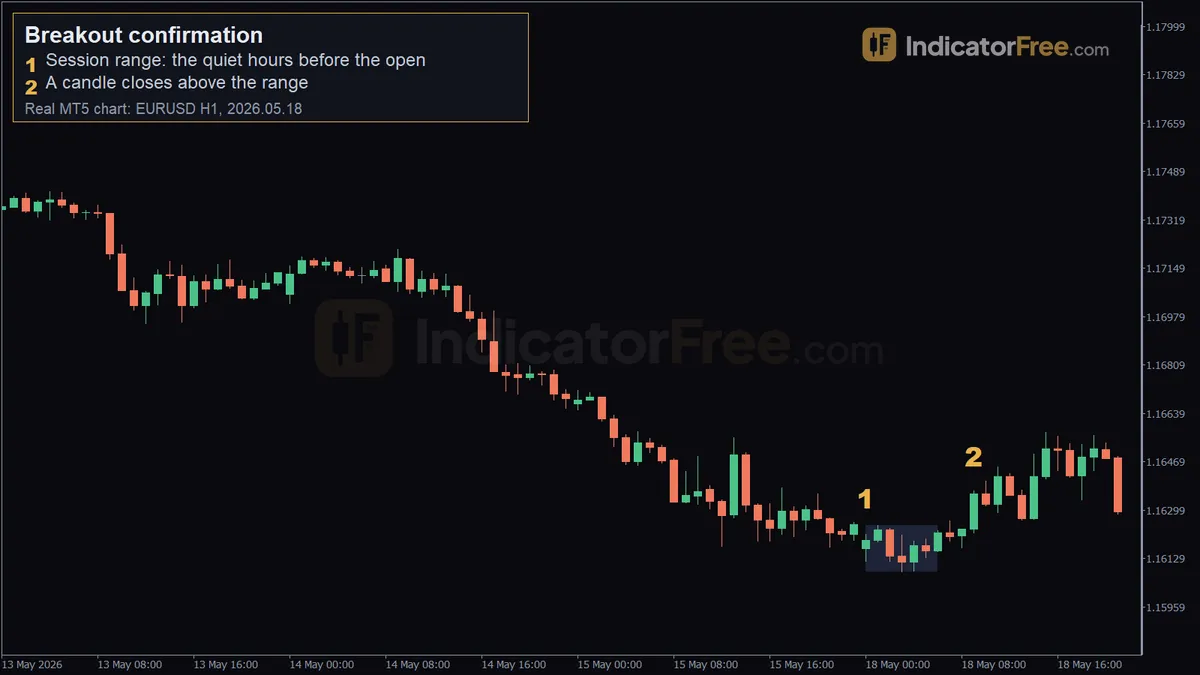
The chart at the top of this page shows EURUSD on the 1-hour chart on 18 May 2026. It is a past example, not a prediction.
Marker 1, the session range (00:00, 1.16213). This marks the quiet hours before the open. Between 00:00 and 06:00, price stayed between 1.16083 and 1.16246, a band of only 16 pips. That gives you two clean edges: the range top at 1.16246 and the range bottom at 1.16083.
Marker 2, a candle closes above the range (09:00, 1.16366). The 09:00 candle closed at 1.16357, with the marker drawn just above it. The close sits 1.16357 − 1.16246 = 0.00111, about 11 pips above the range top. That is roughly two-thirds of the range height beyond the edge, which clears the buffer rule with room to spare. The example gives the 09:00 close but not its open, so you would check point 5 on the chart itself before entering: a body at least twice the average body of the range candles, with the close near the high.
Two ways to trade a confirmed breakout
The two setups below use the real range and close from the EURUSD chart. The stops, targets, account size and lot size are an illustrative example, not a record of trades taken.
Setup 1: Enter on the confirming close
You buy as the 09:00 candle closes at 1.16357. Your stop goes at the range bottom, 1.16083, so only a full failure of the breakout takes you out. That is 27.4 pips of risk, and it is the minimum stop: a buffer below the range would widen it and reduce the lot size slightly. A target of twice the risk is 54.8 pips above your entry. If the 10:00 or 11:00 candle closes back below 1.16246, exit rather than wait for the full stop.
Size the trade from the stop, not from a gut feeling. On EURUSD, one standard lot (100,000 units) is worth $10 per pip. The account size of $13,700 is chosen only so the lot size comes out as a round number.
Notice what the textbook "measured move" target would give here. Add the range height (16 pips) to the range top and you get a target only about 5 pips above your entry. When the confirming close has already travelled most of a range height, that target is too small to be worth the risk. Use a multiple of your stop instead.
Setup 2: Buy the retest of the broken edge
You do not chase the 09:00 close. Instead, you wait for price to pull back toward the old range top at 1.16246. If it holds there, you buy near 1.16246 with a stop 10 pips below the edge, back inside the range. A target of twice the risk puts your take profit 20 pips above your entry.
The risk is about a third of Setup 1's, so you can trade a larger size for the same money at risk. The cost is that the retest may never come, and you will miss some of the strongest moves. The chart below puts both setups on one price scale.
Decision rule: if the confirming close is so far from the edge that your stop would be more than about twice the range height, skip the close entry. Wait for a retest or let the trade go. Here the stop is 27.4 pips against a 16-pip range, about 1.7 times, so the close entry is still allowed.
When breakout confirmation helps and when to stand aside
Confirmation works best when the range is clean, with several touches on each edge. It also helps when the break comes as a busy session opens and more traders arrive, and when it points the same way as the trend on a higher timeframe.
Stand aside just before high-impact news, when one spike can close a candle outside and reverse the next. Also avoid ranges with no clear edges, breaks late in a quiet session, and ranges so wide that the stop would swallow your daily risk.
| Pros | Cons | |
|---|---|---|
| Entry quality | Filters out many wick-only pokes | Entry price is worse than at the edge |
| Stop placement | Gives a clear failure point (close back inside) | Stop is wider after a big confirming candle |
| Discipline | A fixed rule stops impulsive entries | Strong moves sometimes leave without you |
| Retest version | Smallest risk per trade | Many breakouts never retest |
FAQ
What buffer should I use on a 1-hour chart?
Set it as a share of the range height rather than a fixed pip count, so it scales with how quiet the session was. With a 16-pip range like the EURUSD example, a buffer of a quarter of the range is 4 pips. A wider range then gets a wider buffer automatically.
Does volume confirm a breakout in forex?
Spot forex has no single central exchange, so there is no complete volume figure. Most charts show tick volume, the number of price changes, as a rough stand-in. A jump in tick volume on the breakout candle supports the move, but treat it as a secondary check behind the close.
Should I confirm on a higher timeframe than I trade?
A higher timeframe close, such as the 4-hour candle, filters more noise but gives a later entry and a wider stop. A day trader usually confirms on the 1-hour candle and uses the 4-hour or daily chart only for trend direction.