Support and resistance flip
Also called SR flip, Role reversal, Polarity principle, Support turned resistance, Resistance turned support
A support and resistance flip happens when price closes through a level and the level then acts the opposite way: broken resistance becomes support, or broken support becomes resistance.
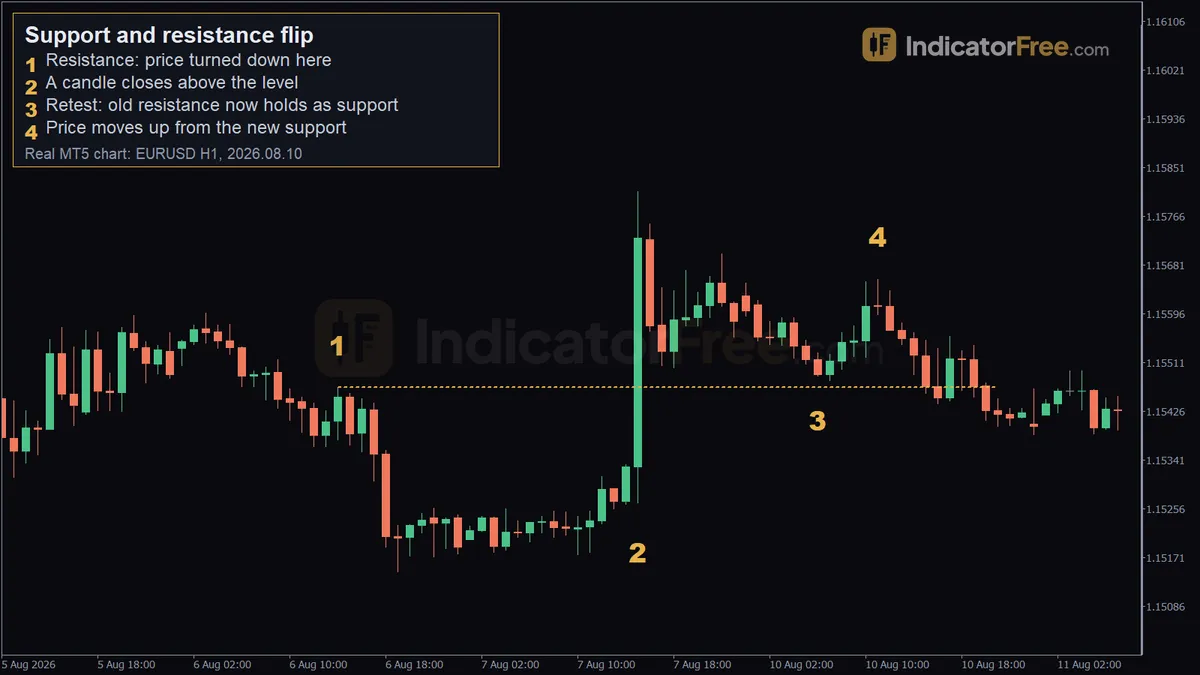
A flip affects your money in two ways. Traders who keep selling old resistance after price has closed above it get run over. Traders who buy the breakout candle often get stopped out on the pullback. Waiting for the flip gives you a calmer entry: price has to come back and show that the level has changed sides.
Bullish and bearish flips
In a bullish flip, broken resistance holds as support, as in the EURUSD example below, and you look to buy the retest. In a bearish flip, price closes below support, rallies back, and the old support caps it as resistance, so you look to sell. Support and resistance on their own, without a flip, are covered in the Support and Resistance entries.
How to spot a support and resistance flip
- Find a clear level where price turned at least once. A sharp reversal or several touches make it easy to see.
- Wait for a candle to close beyond the level on the timeframe you trade. A wick through it does not count.
- Check that the break was decisive. The candle body should sit clearly past the level, not just a few points over it.
- Let price move away, then wait for it to come back to the level. This return is the retest.
- Watch how the retest candles close. In a bullish flip they must close above old resistance. In a bearish flip they must close below old support.
- Only then plan an entry, with the stop loss on the far side of the level.
Valid, weak or broken: judging a flipped level
A strong flip has three parts: a clean earlier reaction, a decisive close through the level, and a retest that holds on closing prices. Wicks may poke into the level. The closes stay on the new side.
A flip is weak when the level was messy before the break, with price crossing it many times. It is also weak when the break came on a small candle, or when price returned at once without first moving away.
A flip is broken when a retest candle closes back on the old side. The level has now failed as resistance and as support, so there is no trade. The chart below shows that failure.
A common misread is treating any touch of the old level as a successful retest. The touch tells you nothing. The close does. Decision rule: if a retest candle closes back across the level, do not enter. If you already placed a limit order, cancel it. Do not widen the stop to "give it room".
The EURUSD 1-hour flip, marker by marker
The chart at the top of this page is a past example on the EURUSD 1-hour chart. It is not a prediction.
- Marker 1, resistance. On 6 August 2026 at 14:00, price turned down at 1.15468. That turning point is the level to watch.
- Marker 2, close above. The candle at 15:00 on 7 August closed at 1.15728. That is 26 pips above the level (1.15728 − 1.15468 = 0.00260), which makes it a decisive close.
- Marker 3, retest. At 06:00 on 10 August, price came back to 1.15488, only 2 pips above old resistance, and held there.
- Marker 4, the move. By 11:00, price had climbed to 1.15656, about 17 pips above the retest.
The detail that matters is at marker 3. Price came within 2 pips of the level and did not close through it. That is what "holding" looks like in practice.
Planning a trade on the retest of a flipped level
Buying the EURUSD retest near 1.15488
The trade plan below is an illustrative example. It uses the real prices from the chart above, with a $10,000 account risking 1%.
- Entry: buy at the close of the retest candle, once it has closed above 1.15468. The example uses 1.15488 for easy maths.
- Stop loss: 10 pips below the entry, which puts it 8 pips below old resistance, so a normal wick into the level does not take you out.
- Target: 1.15728, the close of the breakout candle, 24 pips above the entry.
In the real chart, price reached 1.15656 by 11:00. That is short of the target, so the trade would still have been open. Decide before entering what you will do at that point: take part of the profit, or move your stop to the entry price after the first push.
When a flipped level holds, and when to skip it
Flips tend to be cleaner when the break goes the same way as the larger trend. They are also cleaner when the level shows up on a higher timeframe, and when price moves well away before it comes back.
Skip the trade in a sideways range where price keeps crossing the level. Skip it around major scheduled news, when spikes ignore levels. Skip it when the next opposing level is so close that your target would be smaller than your stop.
| Pros | Cons |
|---|---|
| Entry is close to a clear invalidation point, so the stop is small | Many breakouts never retest, so you miss those moves |
| You need confirmation before you enter | A retest can fake a hold and then close through |
| The same rules apply on any chart timeframe | Judging a decisive close takes practice |
| Easy to size your position from the stop | Messy levels give vague entries and stops |
Practical tips for trading flipped levels
- Draw the level from candle closes and turning points, not from the most extreme wick. That gives you a zone you can trade.
- Mark the breakout candle's close. It makes a natural first target if price rises (or falls) away from the retest.
- Write down, before the retest arrives, which close would cancel the idea. Deciding in advance stops you from talking yourself into a failed level.
- Keep a record of every flip you take or skip, with a screenshot of the break and the retest. Reviewing them shows you which kinds of break you misjudge.
Quick flip checklist
- Clear level with an earlier reaction?
- Candle body closed through it?
- Retest closed on the new side?
- Stop beyond the level, size worked out from the stop?
- Room to the target before the next level?
FAQ
How many retests can a flipped level take before it stops working?
Each retest uses up some of the orders waiting at the level. The first retest is usually the cleanest. Each extra retest makes a break more likely, so be stricter after the first.
How far must price move away before the retest counts?
There is no fixed distance. Look for at least a few candles that close clearly away from the level, so the return is a real pullback and not the breakout candle's own wobble.
What if price never comes back to retest?
Then there is no flip trade. Let it go rather than chasing the move, and wait for the next level to set up.